Posts

Showing posts with the label Wednesday's Wildflower

Wednesday's Wildflower: Tennessee Leafcup

Image
TENNESSEE LEAFCUP,   Polymnia laevigata  Beadle Aster Family (Asteraceae) Submitted by Roger Hammer Polymnia laevigata,  photo by Roger Hammer The lower leaves of this species reach 6"–12" long and 4"–6" wide and are deeply and raggedly cut with pointed lobes, reducing in size up the stem with few or no lobes. The 3'–6' stems are glabrous (smooth). The flower heads are about ½" wide, subtended by a whorl of leafy bracts, and with 3-toothed ray florets and male disk florets.

Wednesday's Wildflower: Atlantic Pigeonwings

Image
ATLANTIC PIGEONWINGS,  Clitoria mariana  L. Pea Family (Fabaceae) Submitted by Roger Hammer, Dade Chapter The upper leaves of this vining species have 3 ovate to ovate-lanceolate leaflets that reach up to 2½" long and ¾" wide. The violet or pink flowers reach 2" long. A similar, related, endemic species ( Clitoria fragrans ) has narrower leaflets, sweetly fragrant flowers, and is known only from the Lake Wales Ridge in Lake, Orange, Polk, and Highlands Counties.

Wednesday’s Wildflower: Seaside Gentian

Image
Seaside Gentian : Eustoma exultatum Submitted by Beryn Harty, Miami-Dade Chapter, resident of the lower Florida Keys Seaside Gentian, photo by Beryn Harty The beautiful Seaside Gentian, Eustoma exultatum , is a herbaceous wildflower found in brackish to fresh wet coastal areas, and inland in wet prairies. The stunning flowers are usually a shade of light to medium purple with a dark purple center, but some flowers appear almost white with dark purple centers.

Wednesday's Wildflower: Southern Beeblossom, Oenothera simulans

Image
Submitted by Jean Evoy, a 30-year veteran of FNPS. She has been active in several chapters including Miami-Dade, Serenoa, and Mangrove. Southern Bee Blossom flower, photo by Jean Evoy Southern Beeblossom is a common wildflower of roadsides, fields, dunes and open woods in Florida.  It used to be called Gaura angustifolia , but a few years ago the evening primrose family underwent extensive revisions and G. angustifolia , was renamed Oenothera simulans along with several other species of that were included in the genus Gaura. Crimson moth larva, J Evoy Southern Beeblossom has slender, branched, hairy stems that may reach six feet. The leaves are reduced on the upper parts of the plant and tiny flowers are found near the ends of wand-like stems. The flowers are white when they open in the evening.    They become pinkish the following day before withering.   As the name beeblossom indicates, the flowers are attractive to many insects, including be...

Wednesday’s Wildflower: Drumheads

Image
Polygala cruciata , Drumheads Text, photos and poetry by Donna Bollenbach. Suncoast Chapter of the Florida Native Plant Society \ Some native flowers are greatly admired, but have yet to make it into our gardens. One is the showy Drumhead, Polygala cruciata. With a few exceptions, Drumheads are found throughout Florida. Like many members of the Polygalaceae or Milkwort family, they like moist, open habitats and are found in moist prairies, the edges of marshes, and wet  pinelands.

Wednesday's Wildflower: Tickseed, Coreopsis spp.

Image
Tickseed, Coreopsis spp. Submitted by Carol Mahler,  Serenoa Chapter of Florida Native Plant Society, edited by Valerie Anderson Coreopsis , photo by Carol Mahler Although the orange blossom, Citra sinensis,  was named our state flower in 1909, the legislature designated the genus Coreopsis as our state wildflower in 1991. According to the Netstate , the story began in 1963 as the Florida Department of Transportation (FDOT) finished a project near Tallahassee that required sod. The sod field had previously been a pasture planted in red clover—a winter forage for cattle. When the clover blossomed in the new grass, people complimented FDOT for their “highway beautification.” That praise inspired FDOT to plant native wildflowers along Florida’s highways . A partnership with the Florida Federation of Garden Clubs funded a research project at Florida Atlantic University. The results recommended many varieties of Coreopsis, and the Federation lobbied for Coreopsis ...

Wednesday's Wildflower: Withlacoochee Noddingcap

Image
WITHLACOOCHEE NODDINGCAPS Triphora craigheadii  Luer Orchid Family (Orchidaceae) Submitted by Roger Hammer, Dade Chapter of the Florida Native Plant Society The fragile, succulent stem of this native orchid averages 1"–2" tall with 1–4 broadly ovate, 3/8" leaves that are dark green above and purple below.  Flowers are about 3/16"  wide and last only 2 hours in the morning.  Plants often produce 2 buds that open a week apart. What this means is that you need to be standing in front of plants in bud during June and July at about 10:00 o’clock in the morning and, if you’re lucky, a flower will open. A clue to a bud opening is it stands straight up the day before if opens. Otherwise the buds are nodding. If you miss it, you’ll have one more chance the following week. If you miss that chance, then you’ll have to wait another year.

Wednesday's Wildflower: Coastal Groundcherry

Image
Coastal Groundcherry, Physalis augustifolia submitted by Carol Tebay, Longleaf Pine Chapter I spent my first winter on the Intercoastal Waterway at Big Lagoon in Escambia County getting to know some of the plants in this scrub dune habitat.  I spotted one plant I couldn't identify. Then, in April, while searching the internet to identify some tracks I’d found in the sand, I came across a list of plants that beach mice depend on for food.  I’d recently spotted one of them, the Coastal Groundcherry, Physalis angustifolia (narrow-leaved).  In this harsh, coastal environment, where I tower over many mature runner oaks, Coastal Groundcherry hugs the ground. Just the right height for a tiny beach mouse. The Groundcherry is a member of the nightshade (Solanaceae) family. Photo by Carol Tebay According to the Atlas of Florida Plants , there are ten native species of Physalis growing in Florida.   While Coastal Groundcherry seems to prefer Gulf Coast counties...

Wednesday's Wildflower: Buttonbush

Image
Buttonbush, Cephalanthus occidentalis Submitted by Jean Evoy, a 30-year veteran of FNPS. She has been active in several chapters including Miami-Dade, Serenoa, and Mangrove. Dorantes skipper on buttonbush by Jean Evoy Every spring I anxiously await the first sign of buttonbush blossoms.  Buttonbush, Cephalanthus occidentalis , thrives in swamps, sloughs, marshes and along the edges of ponds and lakes  throughout most of North American and the West Indies. Even though the flower heads don’t look anything like modern buttons, their pincushion-like structures make buttonbush an interesting and attractive addition to our Florida landscape. Buttonbush by Jean Evoy Buttonbush is an understory shrub, or small tree with arching branches. It has attractive reddish-brown bark and opposite or whorled leaves.  The intriguing globular inflorescences contain numerous bisexual, sessile, white flowers. The fragrant flowers are 4-lobed, with 4 united sepals, 4 stamens and a ...

Wednesday's Wildflower: Star Anise & Florida Anise

Image
Illicium spp., Anise submitted by Tom Palmer, Heartland Chapter Florida has two native species of anise that look quite different and are found in very different regions of the state. Both bloom in spring. Star Anise Star Anise,  Illicium parviflorum ,   Photo by Tom Palmer The Yellow Anise Tree/Star  Anise, Illicium parviflorum , is found in hydric hammocks in a handful of Central Florida counties from Marion to Polk. It reportedly once occurred in Georgia, but has been extirpated. While classified as endangered in Florida, it is locally common in places such as the Marion Creek Basin in northeast Polk County.The type specimen was collected in 1799 in Marion County.

Eastern bluestar

Image
EASTERN BLUESTAR Amsonia tabernaemontana  Walter Dogbane Family (Apocynaceae) Submitted by Roger Hammer Eastern Bluestar, Rover Hammer, roadside ditch along SR65 near Apalachicola. This perennial wildflower reaches 3' tall with smooth stems and lanceolate to elliptic leaves from 3–4" long and ¾"­–1" wide (the uppermost leaves are sessile). It can form large, multi-stemmed clumps and is easy to see when in flower. Pale blue, ¾", star-shaped flowers are in terminal clusters. Flowering season begins in March and lasts into August so look for it in the floodplain forests of the Florida panhandle east to Columbia, Alachua, and Levy Counties. It ranges across the eastern United States to Texas, Oklahoma, and Kansas, and is on its southern range extension in Florida.

Wednesday's Wildflower Whitemouth Dayflower

Image
Commelina erecta submitted by Beryn Harty, Miami Dade Chapter Commelina erecta , photo by Beryn Harty, Roadside, Ramrod Key, FL Whitemouth Dayflower, Commelina erecta,  is a prostrate, herbaceous, perennial wildflower with very showy morning blooms which may bloom throughout the year. The flower is  quarter sized, bright blue, with two larger ear-shaped petals and a small white lower petal (the mouth).

Wednesday's Wildflower: Fewflower Milkweed

Image
Asclepias lanceolata submitted by Lynn Sweetay, Palm Beach Chapter A. lanceolata is tall with a herbaceous stem that does not branch. Leaves are very narrow and lanceolate. Flowers are orange to red and yellow. Flowering occurs in early summer. It is a larval host plant for monarch and queen butterflies and a possible larval host for soldier butterflies as well as providing nectar for monarch and other butterflies and insects.

Wednesday's Wildflower:Spanish Needle

Image
Spanish Needle, Bidens Alba Submitted by Donna Bollenbach, Suncoast Chapter Biden's alba , all photos by Donna Bollenbach Nothing attracts more butterflies and bees than a simple white flower called Bidens alba . Also called Romerillo, Beggar’s Tick, Spanish Needle or Monkey’s Lice, this Florida native wildflower is the third most reliable source of nectar for pollinators in our state. There would be many starving bees and butterflies if not for the Bidens family of flowers. More so, Bidens alba and its sister plant, Bidens pilosa , are both edible and have medicinal value. Yet, many gardeners have a love/hate relationship the plant, and some even consider it a pesky weed. Why?

Wednesday's Wildflower: Scrub Lupine

Image
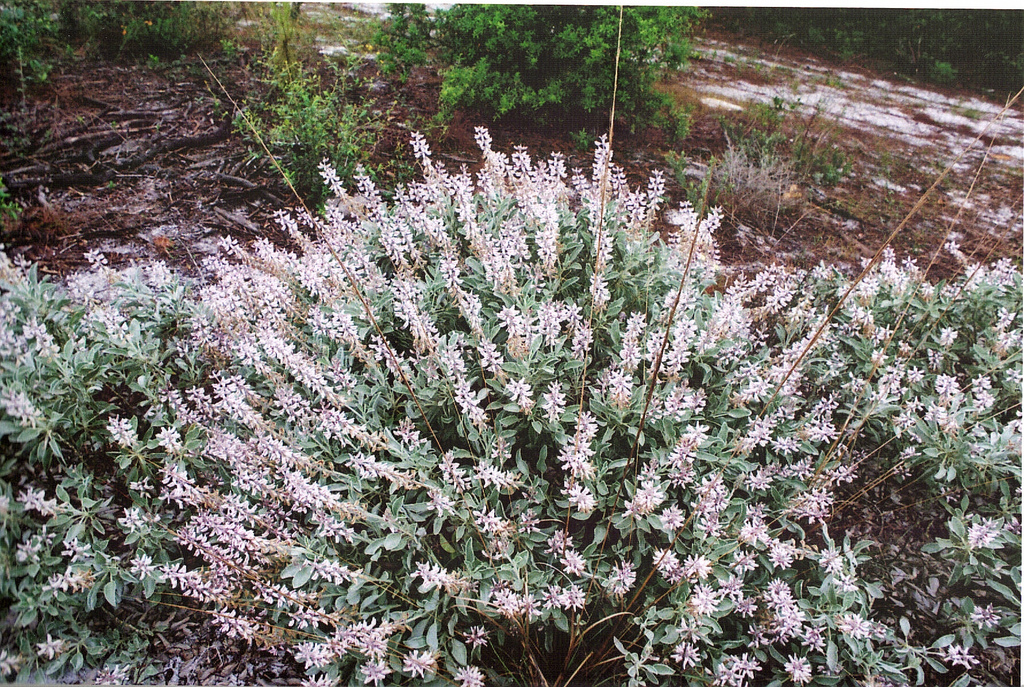
McFarlin’s Lupine/Scrub Lupine,  Lupinus westianus var. aridorum / Lupinus aridorium Submitted by Tom Palmer, Hernando Chapter Scrub Lupine, photo by Tom Palmer This pink-flowered endemic wildflower blooms in spring in a decreasing number of locations on the Winter Haven and Mt. Dora ridges in Polk and  Orange counties.  It is a federally listed endangered species, and unlike many scrub species, it is  unknown within the Lake Wales Ridge.  Although this plant was first proposed to be considered a separate species by James Brigham McFarlin in the 1930s, it was not formally described until 1982 by John Beckner. It was later reclassified as a variety of Lupinus westianus by Duane Isley, but a current genetic evaluation of Florida lupines reportedly may result in changes in the nomenclature that may restore it to full species status. Scrub lupines are easily identified by pink blossoms as well as the absence of stipules, which will L. diffusus...

Wednesday's Wildflower: Common Blue Violet

Image
COMMON BLUE VIOLET, Viola sororia Willd. Violet Family (Violaceae) Submitted by Roger Hammer Viola sororia, photo by Roger Hammer The nearly orbicular, toothed leaves of this common species form a rosette measuring up to 3" across. The flowers reach ¾" wide and range from pale to rich blue (rarely white). It is not stoloniferous like many other members of the genus but may form dense colonies, especially along moist trails that bisect its habitat. It principally blooms from January through July in mesic forests throughout mainland Florida but plants may be found flowering throughout the year. In cultivation, it will spread from seed in pots and wherever there is moist, bare soil in shady situations. The seeds of many violets are explosively dehiscent and can be flung several feet away from the parent plant. Viola is the classical Latin name for a violet and the name sororia means “sisterly,” alluding to its similarity to other violets. It is the state wildflower of W...

Wednesday's Wildflower: Common Torchwood

Image
Amyris elemifera , Common Torchwood By Beryn Harty, Dade Chapter , edited by Valerie Anderson Photo by Beryn Harty, Taken on roadside, Ramrod Key, FL Family Name: Rutaceae Genus/Species: Amyris elemifera Common Name: Common Torchwood (Another common name is Sea Torchwood, which is deceiving because it's salt tolerance is rather low. According to the IRC, " It grows near salt water, but should be protected from direct salt spray by other vegetation." Native Range: Eastern peninsular Florida, the West Indies, Mexico and Central America (Belize) What kind of plant is it? : A flowering tree Any interesting history : Green wood used as torches, twigs are burned as incense. What is the shape, color and size of the flower ?: Clusters of tiny white flowers, new leaf growth often very dark purple What is the typical natural habitat? Hammocks What benefits does it have for wildlife? Provides food and cover for wildlife. Larval host for Bahamian and Schaus Swallowtail...

Jack-in-the-Pulpit, Arisaema triphyllum

Image
Submitted by Tom Palmer, Hernando Chapter . Edited by Valerie Anderson Jack-in-the-Pulpit, photo by Tom Palmer Jack-in-the-Pulpit ( Arisaema triphyllum ) emerges in floodplain forests in most of Florida at the beginning of spring. The plant’s Latin name refers to its three prominent leaves that spread above the spathe that is the “pulpit” from which the common name (also known as Parson-in-the-Pulpit) derives. Purple splotched spathe. Photo by Tom Palmer The spathe ranges from green to purple. The plant also includes a cluster of red berries that ripen later in the year. This plant is widespread, growing all over the Eastern United States and as far north as Nova Scotia. However the plant is not uniformly distributed and sometimes may be absent or infrequent in suitable habitat. Arisaema triphyllum was once divided into two species ( A. triphyllum and A. acuminatum ) based on morphological differences described by Small and others. It was originally desc...

Wednesday's Wildflower: Venus Looking-Glass

Image
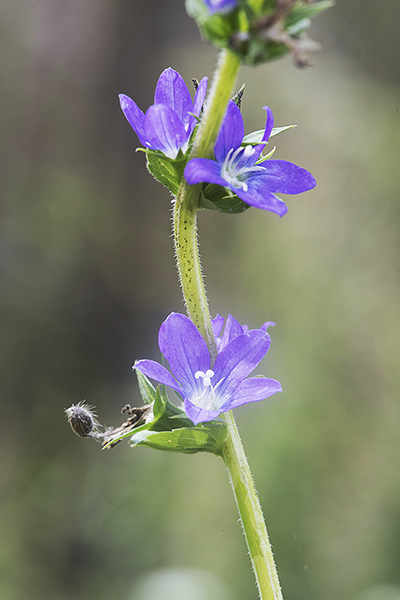
Triodanis perfoliata  Bellflower Family (Campanulaceae) Photo and text submitted by Roger L. Hammer , Dade Chapter Venus’ looking-glass is a native herbaceous annual with hairy, ribbed stems and ovate to elliptic, alternate, clasping leaves that reach about ⅜"–¾" long. The axillary, sessile, 5-lobed flowers measure about ⅜" across.  Look for this species from February into May, mostly along roadsides and other disturbed sites through the Florida panhandle, across the northern peninsula, and south in the peninsula to Pinellas, Hillsborough, Hardee, Polk, Osceola, and Volusia counties. Globally it ranges from Argentina northward throughout the United States into British Columbia, Ontario, and Quebec. Native Americans made a tea of the roots and leaves to help relieve indigestion and also “to make one sick all day” as a treatment for overeating. The leaves were also smoked during ceremonies.         Triodanis  means ...

Wednesday's Wildflower: Florida Greeneyes

Image
Berlandiera subacaulis Submitted by Jean Evoy, a 30-year veteran of FNPS. She has been active in several chapters including Miami-Dade, Serenoa, and Mangrove . Lobed basal leaves and hairy stems, photo by Jean Evoy There are a lot of plants that say “spring”, but one of my favorites is the endemic Florida Greeneyes, Berlandiera subacaulis, named for Jean-Louis Berlandier, a Swiss Physician who collected plants in the early 1800s. Greeneyes, photo by Jean Evoy Seedhead of the Greeneyes photo by Jean Evoy This drought tolerant plant grows throughout most of the Florida peninsula in sandhills, dry flatwoods, and disturbed sites in acid to neutral sandy or loamy soils.  The related Soft Greeneyes, Berlandiera pumila, grows in  the Florida panhandle and south to Marion and Volusia Counties. Greeneyes flowers are a common sight along roadsides in central Florida. This short-lived perennial can be grown from root division or seeds that are quite easy t...