Posts

Showing posts with the label Florida

Wednesday's Wildflower: Blackberries
Image
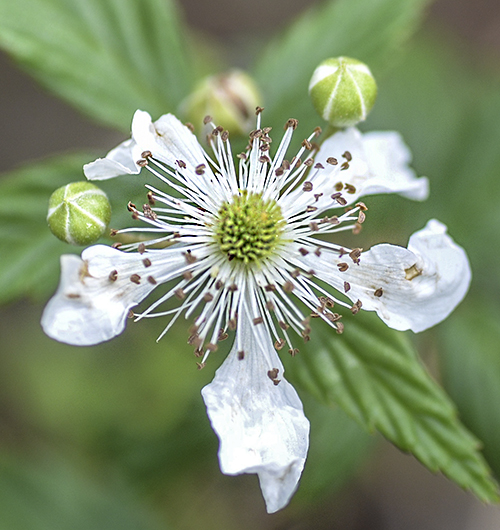
Native Blackberries, Rubus spp.  Submitted by Tom Palmer, Hernando Chapter Blackberry Flower, Rubus spp. Tom Palmer, Hernando Chapter The lovely white blooms of Florida’s various species of native blackberries (Rubus sp.) in late winter and early spring offer plenty of food for wildlife ranging from Florida black bears to songbirds in late spring. Bee visiting a Dewberry Flower, Photo by Donna Bollenbach The flowers attract bees and other pollinators. Wild Blackberries photo by Donna Bollenbach Blackberries are common in dense thorny patches along roadsides and in natural areas throughout north and central Florida. The fruit is composed of drupelets that vary in the sizes of the drupelets and the size of the fruits. Although fruiting in central Florida typically occurs in late May or early June, I have observed some fruiting as early as late March. For people, the flowers offer the promise of cobblers and pies at Fourth of July pic...

DON'T CUT DOWN THAT SNAG

Image
Submitted by Donna Bollenbach Courtesy of Wikimedia  The Wildlife Tree SNAGS, often referred to as “The Wildlife Tree”, are dead tree trunks that are still standing. They provide perches, food and nesting sites for birds and other wildlife. Wildlife also uses dead wood as landmarks for navigation, basking platforms, perching and nesting. Cavity Dwellers Nearly 40 species of birds and several species mammals in Florida nest in tree cavities.Woodpeckers, are a “primary excavators.” Owls, Blue-birds, Squirrels and Nuthatches are a few of the “secondary cavity users.” Photo by Donna Bollenbach Snags as Perches Many birds perch high on snags so they can spot prey below. Some birds perch on snags for the greater visibility to a potential mate. Snags as Cover Birds and small mammals take shelter in the cavities of trees Bees may also create hives in tree cavities. Snags for Nesting Ospreys and eag...

Wildflower Portraits: 10 Tips for Taking Great Close-up Images of Native Plants

Image
Submitted by Donna Bollenbach, Suncoast Chapter / Nature Photographer Taking great close-up images of wildflowers is no different than taking great photographs of people, except the wildflowers won’t ever tell you they look “too fat” or “too old” or “too plain.” But, like people portraits, there are a few tips to taking outstanding wildflower portraits: 1. Get close, but be mindful: If it is the flower you are after, get as close as you can without damaging the plant or the habitat. If you want people to be able to identify a plant from your image, be sure to include features that are unique to the species, such as leaves, fruits or seeds. Celestial Lily,  Nemastylis floridana , a rare endemic. 2. Be level: The closer you are to a subject, the less depth-of-field you will achieve. So, position your camera so the lens is parallel with the flower, or other feature of the plant, that you want to be the sharpest. If you have a depth of field preview on your ...

A Pine can have lightning scars that run down the trunk. Why doesn't an Oak?

Image
  by Cecilia Catron , Tarflower Chapter of the Florida Native Plant Society (reprinted with permission from the August 2016 issue of Tarpaper ) Pine Scar  When days are hot, as they have been for the past month, it seems like a sensible idea to lie in or around the pool all day, like a motionless alligator. Curds of bright, white thunderheads rise higher and higher, expanded by the increasing heat. Gradually air pushed from the east and west coasts meets in the middle of the peninsula. By mid-afternoon it becomes charged by the collision of the fronts and summer lightning is created, with or without a storm. Knotty Oak Have you ever noticed a stripe spiraling down the trunk of a pine tree where lightning has stripped the outer bark off? You may have also noticed there is no such stripe on the trunk of an oak tree. Oaks and Pines, both dominant here in central Florida, have different ligh...

LICHENS – A TAPESTRY OF LIFE

Image
by Donna Bollenbach The tiny moss has been the theme of many a gifted poet; and even the despised mushroom has called forth classic works in its praise. But the Lichens, which stain every rock, and clothe every tree, which form:                           Nature’s livery o’er the globe Where’er her wonders range Have been almost universally neglected, nay despised. Lauder Lindsay Christmas Lichen on a fallen tree, Florida.  PIONEERS Imagine our continent after the last ice age: Glaciers cut deep gorges in the land and miles of granite boulders, silt and the bones cover the hills and plains of North America. Life has all but disappeared, but there is hope for new life in a simple living entity that is neither plant nor animal, the lichens . Lichens on a rock in Yellowstone National Park.  Lichens, a partnership of a fungus and an alga, are able to survive in the most extreme temp...

A Butterfly Journey

Image
Story and Photos by Ryan Inskeep COMMENT Collage of Native Florida Butterfly Wings I will always remember the day my journey started , just five years ago.I was strolling through the nursery on a typical hot summer day when a  beautiful native milkweed plant caught my eye. At the time I was drawn to the blooms alone (not realizing the many benefits this one plant would  soon provide). It was not long before the female Monarch butterfly flew in to lay her eggs on the Milkweed. Suddenly, my entire outlook on gardening  changed.  If this one plant could bring in so much life, imagine what would happen if more native plants were added. I began by incorporating  butterfly larval host plants and adult butterfly nectar plants. Implementing both host and nectar sources allows the butterflies to  complete their entire lifecycle in my small urban garden.  (Top left to right: Black Swallowtail on Cirsium horridulum, White P...