Posts

Showing posts with the label edible plants

Wednesday's Wildflower: Blackberries
Image
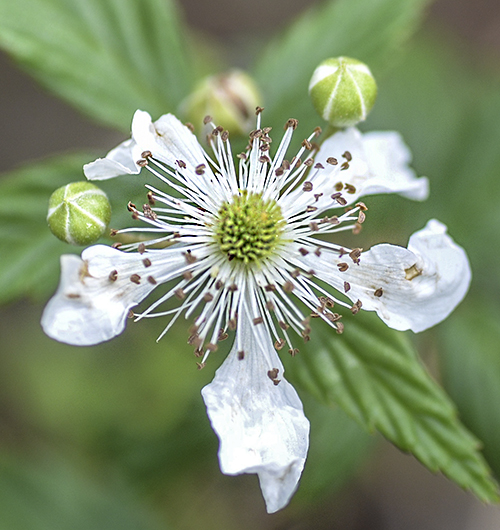
Native Blackberries, Rubus spp.  Submitted by Tom Palmer, Hernando Chapter Blackberry Flower, Rubus spp. Tom Palmer, Hernando Chapter The lovely white blooms of Florida’s various species of native blackberries (Rubus sp.) in late winter and early spring offer plenty of food for wildlife ranging from Florida black bears to songbirds in late spring. Bee visiting a Dewberry Flower, Photo by Donna Bollenbach The flowers attract bees and other pollinators. Wild Blackberries photo by Donna Bollenbach Blackberries are common in dense thorny patches along roadsides and in natural areas throughout north and central Florida. The fruit is composed of drupelets that vary in the sizes of the drupelets and the size of the fruits. Although fruiting in central Florida typically occurs in late May or early June, I have observed some fruiting as early as late March. For people, the flowers offer the promise of cobblers and pies at Fourth of July pic...

Dotted Horsemint: an Appreciation

Image
A short piece about a tall mint… The purple dots on the pale flowers are the reason for the common and scientific names. The flowers are arranged in a whorl above the pinkish bracts. Dotted horsemint or spotted beebalm ( Monarda punctata ) is found in all but the southernmost counties in Florida and its range continues northward to include three Canadian provinces, westward to Wisconsin southward to New Mexico and jumps over to California. ( USDA plants page , FNPS plants page ) The dotted horsemint is an herbaceous perennial that dies back in the winter in north Florida and comes back from the roots. It seeds readily, so once you have some, you can collect the seed in the late fall and sow them into pots or spread on soil that has been raked to loosen the crusty layer. It occurs along roadsides, on sand dunes, in meadows, in scrub areas, and in butterfly gardens–it is an incredible insect magnet. The height depends on the soil: in a sand dune, it will grow to about a...

A Native Herb Has Earned an Honored Place Amongst the Mediterranean Species

Image
I found some meadow garlic ( Allium canadense ) growing in a low spot in my yard. I dug it up and planted it next to my rosemary bush in the herb garden. Over the years, I've found more and have planted the little bulblets that it produces each year and now there's a good stand in the garden. We have a few native alliums here in Florida. The one I have is the most widespread according to Wunderlin, R. P., and B. F. Hansen. 2008. Atlas of Florida Vascular Plants ( http://www.plantatlas.usf.edu/ ). It occurs from the panhandle down to central Florida. The Mobile meadow garlic ( A. canadense var. mobilense ) is located only in the panhandle counties and has mostly pinker flowers with all flowers in each flower head--no bulblets. The striped garlic ( A. cuthbertii ) is rare in Florida and occurs only in the eastern-most counties in northeast Florida. It also has only flowers in its flower heads and its petals are narrower and often have a pink stripe down the middle. Unlike the ...