Posts

Showing posts with the label Gopher tortoise

Field Trip to Ashton Biodiversity Research and Preservation Institute

Image
On January 20 2018 several members of the Paynes Prairie chapter traveled to Ashton Biodiversity R esearch and Preservation Institute (ABRPI). Chase Pirtle, the animal care specialist and habitat  manager met us at the gate. Chase is an authorized Gopher Tortoise Agent and an instructor and  private land manager for the Eastern Diamondback Conservation Foundation. He also holds a FWC  venomous license. We drove in to the Headquarters and met Maggie Curtis, also a biologist at Ashton who assists Chase in t he management of the facility. The headquarters also serves as an incubator, nursery and cold weather  shelter for the tortoise collection. In large tubs and kiddy pools filled with pine needles and turkey oak  leaves are several Radiated Tortoises (native to Madagascar) and a Yellow Footed Tortoise (native to  South America).  Radiated  Tortoises are critically endangered in Madagascar and these are the  descendants of  ...
Life in the Slow Lane: A Profile of the Gopher Tortoise

Image
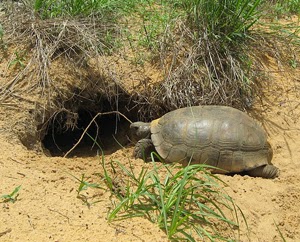
By Laurie Sheldon Gopher tortoise entering burrow; photo by Gary Foster. Joseph Butler, a U.N.F. Biology Professor and herpetologist, was a guest speaker at one of  the Ixia chapter's recent meetings. He hoped to study snakes when he moved to Florida, but found that they were hard to pin down, so to speak. He turned his attention to Gopher Tortoises, which proved to be a much more reliable subject to study, as they live long lives (50 years +) and there are over 400 burrows on campus.The gopher tortoise is federally protected as a threatened species except in Florida, where it is listed as a Species of Special Concern by the Florida Fish and Wildlife Conservation Commission. Gopher tortoises ( Gopherus polyphemus ) are native reptiles that can be found throughout the southeastern U.S.. They prefer sandhill communities, which are typified by longleaf pines and turkey oaks growing in loose, sandy soil. Much of the longleaf pine in Florida has been replaced with slash pine, wh...