Posts

Showing posts with the label suburbia

Add Native Plants to Your Landscape

Image
by Donna Bollenbach A few years ago my parents decided that they could no longer keep up with the maintenance of their home. They moved in with my sister, and asked my husband and I if we would like to live in their house. As we were between homes, we accepted. The move from a country home on a two wooded acres to a suburban home on a 1/3-acre lot with a tropical landscape was quite a change for us. We missed our native trees and shrubs and all the wildlife they attracted. The tropical vegetation was pretty, but had very little attraction for the wildlife.   We joined the Florida Native Plant Society Shortly after moving, we joined the Suncoast Native Plant Society . We learned that the native plants we took for granted in our rural home attracted more wildlife because they preferred natives for food and shelter. In our rural landscape we had very little grass, but lots of oaks, longleaf pines, beautyberry, firebush, pokeweed, dewberry, holly, sweetbay, Caroli...
The Importance of Native Plants, Part 2

Image
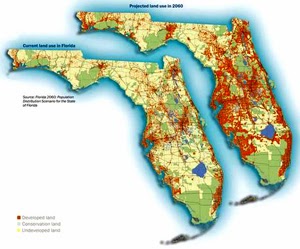
The following article, which features Dr. Doug Tallamy's book, Bringing Nature Home , was submitted by Karina Veaudry, FNPS Landscape Committee Chair. Excerpts of Tallamy’s original text were reprinted with his permission. For part 1 of the article, click HERE . Landuse in Florida today and predictions for 2060; the rust color depicts developed land, green is conservation and yellow is undeveloped. Your Role in Building Biological Corridors: Networks for Life Throughout the U.S., we have fragmented the habitats that support biodiversity by the way we have landscaped our cities, suburbs, and farmland. This is a problem because isolated habitats cannot sustain themselves or support populations large enough to survive normal environmental stresses. We can reconnect viable habitats by expanding existing greenways, building riparian corridors, and by changing the landscaping paradigm that dominates our yards and corporate landscapes. Replacing half of our lawns (areas that are e...

The Importance of Native Plants, Part 1

Image
The following article features Dr. Doug Tallamy's book, Bringing Nature Home , was submitted by Karina Veaudry, FNPS Landscape Committee Chair. Excerpts of Tallamy’s original text were reprinted with his permission. The Need to Plant Natives in (sub)Urban Landscapes As development and subsequent habitat destruction accelerate, there are increasing pressures on wildlife populations. But there is an important and simple step toward reversing this alarming trend: Everyone with access to a patch of earth can make a significant contribution toward sustaining biodiversity. There is an unbreakable link between native plant species and native wildlife - native insects cannot, or will not, eat non-native plants. When native plants disappear, so do native insects; subsequently, the food source for birds and other animals is dramatically reduced. In many parts of the United States, habitat destruction has been so extensive that local wildlife populations have entered a state of crisis and ...