Posts

Showing posts with the label "Florida-friendly"

Bank with Natives in Steinhatchee by Jaya Milam

Image
Big Bend Chapter completed a native plant conversion for our local Citizens State Bank .  We transformed the garden beds from all non-native to all native ! The bank's managers were delighted with the results. They were very pleased to know that there is very low maintenance and the garden beds will shine with natural beauty most of the year! Through this project we were able to share much information regarding the quality and sustainability of going native with many in our community that go past our beautiful Native transformations and get to enjoy the natural beauty.  We were provided the privilege to put our Big Bend Chapter Sign discretely in the corner of each flower bed to encourage folks to consider native when gardening at their home or business facility.  We have received numerous compliments and commendations from many customers and folks just passing by....Go Native, it’s contagious!

Field Trip to Ashton Biodiversity Research and Preservation Institute

Image
On January 20 2018 several members of the Paynes Prairie chapter traveled to Ashton Biodiversity R esearch and Preservation Institute (ABRPI). Chase Pirtle, the animal care specialist and habitat  manager met us at the gate. Chase is an authorized Gopher Tortoise Agent and an instructor and  private land manager for the Eastern Diamondback Conservation Foundation. He also holds a FWC  venomous license. We drove in to the Headquarters and met Maggie Curtis, also a biologist at Ashton who assists Chase in t he management of the facility. The headquarters also serves as an incubator, nursery and cold weather  shelter for the tortoise collection. In large tubs and kiddy pools filled with pine needles and turkey oak  leaves are several Radiated Tortoises (native to Madagascar) and a Yellow Footed Tortoise (native to  South America).  Radiated  Tortoises are critically endangered in Madagascar and these are the  descendants of  ...

Who Doesn't Love a Cocoplum?

Image
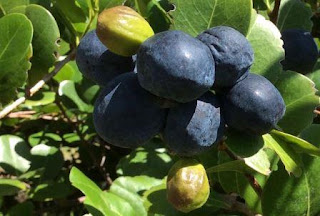
Who Doesn't Love a Cocoplum? By Ellen Broderick Photo by Ellen Broderick Easy to grow here in Martin County with dark purply-blue plums, occasionally white, or unusually pink. Wildlife hide and feast among the offerings of  Chrysobalanus icaco.  In the planned landscape cocoplum's full leafy branches work well as screens, or they can be shaped within garden islands, and even survive buzz-cuts in parking lots. Naturally they grow in South Florida swamps, moist forests, coastal beaches and thickets. Post hurricane their naked branches re-bud and grow new leaves without much fuss.  If you've been around for a while you might know us as the "Cocoplum Chapter." The name was always Martin County but somewhere along the way we picked up the Cocoplum tag. For clarity and with a nod to the Martin County difference we've reclaimed our true name. But it's no big deal if you want to keep calling us cocoplums. They are, after all, very sweet in ...

FNPS Citrus Chapter Member Honored

Image
The Citrus Chapter awarded chapter member, Barbara McCormick the 2018 Green Palmetto Award for Education at our Sept. 4th chapter meeting. The nomination letter was read to the audience. The chapter also gave Barbara a gift card as a thank you for all she does for our chapter along with a bouquet of native bloomers. Barbara's nomination letter is below. March 14, 2018 Citrus County Florida Barbara McCormick, a native Floridian, veteran and former Army officer, joined the Citrus Chapter of the Florida Native Plant Society in 2003. She brought with her many years of experience as a Master Gardener and horticulturalist at Walt Disney World’s University of Disney Garden program while attending Valencia College. In 2002 Barbara started her own nursery named Nature by Design which specialized in native plants as well as Florida friendly plants. Unfortunately the nursery was destroyed by the back to back storms of 2004. Since then, while working as a private co...

Florida Native Plant Society: Faithful Friends of Florida’s Flora

Image
Anyone who considers themselves to be the least bit knowledgeable in a field pertaining to plants will tell you that Florida holds some of North America’s finest examples of natural flora. While many explorers of the southern-most state will more often return home with stories of alligators, manatees or Disney World, it is truly the towering trees, radiant flowers and tranquil wetlands that are deserving of awe and admiration. What accompanies such attention however, is a constant need for protection, preservation and education where the many multitudes of Floridian plant species are concerned. With a focus on those species that have been growing naturally in the region since before the founding of America, the Florida Native Plant Society fights on the front lines for the rights of the region’s native flora, be they land or water based. From Seeds to Trees: The Early Years Founded in early in the summer of 1980, the creation of the non-profit Florida Native Plant Society ...

Why your Florida garden needs Yucca plants, and how to grow them

Image
Yucca plants are evergreen plants with interesting, usually spiky, leaves that bloom into bunches of flowers. There are  over 20 species of yucca  and three are native to Florida. These are the Spanish Bayonet, Moundlily Yucca, and Adam's needle. Spanish bayonet (Yucca aloifolia)  Photo credit: Shirley Denton Growing yucca plants in Florida is a great way to encourage indigenous plants to thrive, while benefiting birds and pollinators. If you grow native Florida plants, they also require less TLC because they're in their natural environment. Here’s what you need to know about Yucca plants. The three species of Yucca plant that are indigenous to Florida are beautiful ways to encourage a more creative and healthy garden. Here's how to identify them so you can choose the one that feels perfect for your garden and needs. 1. Spanish Bayonet (Spanish Dagger) This evergreen plant is marked by sharp tips and two-foot leaves. It can reach up to 20 feet in he...

CENTRAL FLORIDA NATIVE AND WILDLIFE FRIENDLY YARDS TOUR

Image
Produced and Submitted by Mark Kateli, Tarflower Chapter This was yet another great year with the "sister society" collaboration for the Central Florida Native and Wildlife Friendly  Yards Tour .  Florida Native Plant Society Tarflower and Cuplet Fern chapters, and the Orange Audubon Society, host this event annually. It's a great exercise to help strengthen our bond around a common mission. This year, we had well over 100 attendees.  A special thanks to noted environmental journalist Kevin Spear that published an article in the Orlando Sentinel that promulgated the event to people outside our usual sphere of influence. Being Tarflower chapter Treasurer, I firmly believe that as we prosper, so will our neighboring chapters.  I look forward to hearing from chapters that border Orange County- Lake, Osceola, Brevard, Volusia, and Polk chapter Treasurers- for more collaborative ideas that amplify attention t...

Our Beautiful Subtropical Garden

Image
By Mary Ann Gibbs When my husband, Tucker, and I bought our house in Miami some 16 years ago, we inherited a yard that was mostly grass with five large melaleuca trees, several Queen palms and a Surinam cherry hedge. We tore all of that out and evolved our yard into what it is today – a haven for people and wildlife. There is a sense of beauty and peace in the garden where we can observe the birds, butterflies, bees, squirrels and other critters that share our space with us. A more than 15-year-old lignam-vitae tree on left is the standout in our new hedge planted with many young native trees and bushes, including here coral-bean, golden dewdrop, satinwood and Florida Keys blackbead. Growing up the chicken wire around a fishtail palm to the right of the lignam-vitae is passion vine, a larval host for heliconian butterflies. The bromeliads in the front will come out as the young slow-growing natives fill up and out. We have never liked grass in our yard. We replaced m...

Everything you need to know about the Florida-Friendly program, but were afraid to ask! Part 1

Image
You may have heard the term "Florida-Friendly" used in articles about the controversial law (HB2080) that passed last year and in presentations by your agriculture agents, and you may even have visited the Florida Yards website.  I thought I was fairly well educated on the topic, but when I met Mike Thomas in Tallahassee earlier this year on my book tour, I realized that there was so much more to think about.  And now with the new 104-page book, "Florida Friendly Landscaping," I thought you'd be interested in knowing more, too.  This is Part 1 of my interview with Mike.  Please feel free to ask more questions and leave your comments.  Thanks for reading. Ginny Stibolt An interview with Mike Thomas, Ph.D., P.E. on the Florida-Friendly program, a state-wide effort to educate homeowners and property managers to have less impact on the environment. Their nine principles of better and water-wise landscaping practices cover a wide range of topics from attr...