Posts

Showing posts with the label activism

Why Florida Native Plant Month?

Image
A New Initiative As the weather turns nicer and chapter events start increasing, the Florida Native Plant Society is starting a new initiative for the fall this year.  Welcome to the first ever Florida Native Plant Month!   You can find a list of events at http://fnps.org/news/plantmonth . The St. Johns County Proclamation of October being Florida's Native Plant Month  We are working on a coordinated outreach and membership campaign to tell everyone we can find in the state about the work FNPS does.  As part of this, we are building relationships with local elected officials, media and organizations who may not know much about us. The proclamation document. There are currently 36 scheduled proclamations across the state for an event FNPS decided to proceed with in late July.  We have already found people that share a similar mindset as FNPS who were not members.  One of the coolest stories so far is a City Commissioner reaching out to us beca...

Film premier: Florida Wildlife Corridor Expedition Documentary

Image
The Wildlife Corridor By Ed Murawski, FNPS Heartland Chapter Florida Wildlife Corridor Expedition: Everglades to Okefenokee Documentary Film  On Sunday March 3, 2013, the Heartland Chapter attended the Tampa premiere of the documentary film, Florida Wildlife Corridor Expedition: Everglades to Okefenokee, produced by Elam Stoltzfus. This film documented the 100 day, 1,000 mile trek across the state of Florida from the southern edge of the Everglades to the Okefenokee National Wildlife Refuge at the Florida-Georgia border. The journey was documented by photographer Carlton Ward Jr., filmmaker Elam Stoltzfus, conservationist Mallory Lykes Dimmitt, and bear biologist Joe Guthrie. The expedition team hiked, paddled, and rode horseback along their journey. The premier took place at the Cotanchobee Park next to the Tampa Bay History Center.  Over 500 attendees braved the very cold and windy conditions to be the first to see this wonderful film.  I have to say, ...

National Invasive Species Awareness Week 2013

Image
by Laurie Sheldon History and Definition President Bill Clinton On Feb 3, 1999, President Bill Clinton signed Executive Order 13112 - a critical piece of legislature on the environmental front. It established a multi-agency task force (the National Invasive Species Council) to deal with the management of " invasive species ," which it defined as a species: that is both non-native (or alien) to the ecosystem under consideration and whose introduction causes or is likely to cause economic or environmental harm or harm to human health. These "invaders" present themselves in many forms, and include (but are not limited to) plants, animals, and pathogens.   I found an air potato as big as my hand at a Roundup during NISAW 2012: air potato has been listed as one of Florida’s most invasive plant species since 1993. Causing Harm Invasives may feed on fish and wildlife and/or cause widespread illness. Invasive pathogens can kill forest trees....

Celebrate Florida in 2013

Image
Little Talbot Island by Shirley Denton Florida has so many wonderful parks and wild places to visit. Show your support by visiting a bunch of them this year. The parks are working on slimmer budgets these days so your visits not only help them balance the budgets, but greater use also helps them justify their existence to the budget deciders in the state government. You can also support your state parks by volunteering on a regular basis and also by letting your state representatives know how you feel about our wonderful state parks. Recently on Facebook, John M. sent us a message: "Next week two of us from Birmingham Botanical Gardens will be traveling from Birmingham to Lee, FL, then to Florida Caverns State Park, and finally to the Pensacola area to participate in a sarracenia rescue. We are interested in visiting some botanically interesting areas along the way. Might you have any suggestions? Kind thanks, John Instead of trying to answer the question myself, ...

2011 FNPS Annual Report

Image
 The Florida Native Plant Society has released its annual report for 2011 . Please read the whole report for yourself to see how much our organization accomplishes in one short year. What I've included here are some screenshots to give an idea of what is included.   From FNPS president Steve Woodmansee: Restoration of our native habitats begins with the native plants appropriate to our areas. The continued protection of our remaining natural habitats is also critically important. After all, these are the refugia where our native wildlife still survives. For these reasons I actively support the Florida Native Plant Society. These pages illustrate some of the many Florida Native Plant Society achievements in 2011. Help us continue to preserve Florida’s natural heritage, native plant by native plant community.     What is notable about the FNPS operating expenses pie chart is that a full 80% of our expenses is for programs. We are very efficient! ...

Grass-free and Deed-Restricted: An Impossible Dream?

Image
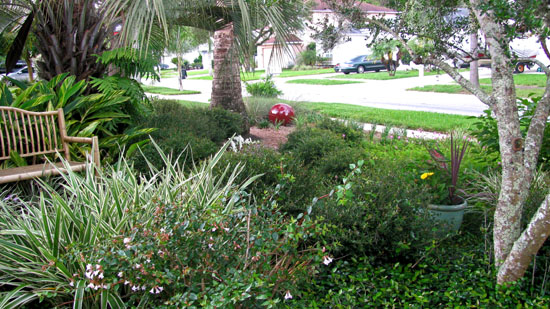
 An impossible dream in an HOA-controlled community? Pam Brown's front yard In Pinellas County.  by Nanette O’Hara I hear it all the time. Folks who live in deed-restricted communities tell me they can’t remove even a blade of grass from their front yard for fear of recrimination from their evil HOAs. But is this really the case? Probably not. I think acceptance of “non-traditional” landscapes depends largely on how you deliver your pitch, and the effort you put into making your case for an alternative to the typical turfgrass-dominated yard with a couple of scraggly palm trees and a neatly manicured hedge of shrubs along the front of the house. State laws enacted in recent years make it clear that HOAs cannot prevent homeowners from implementing Florida-Friendly landscapes. Many homeowner associations may not be aware of this (especially if no one has bothered to inform them about it), and still more are unclear about what a “Florida Yard” looks like. They fear, unders...

The Danger of Moving Firewood: Florida’s Newest Tree Disease

Image
This redbay tree that has been killed by the terrible laurel wilt disease. All the leaves turn brown without warning. If you have ever gone camping, you probably have moved firewood. It is a pretty natural thing to do. However, today, Florida is rapidly loosing an important member of its forest tree and shrub diversity: members of the Lauraceae plant family are being killed by a new pathogen. The following trees and shrubs are susceptible to the laurel wilt disease: swampbay ( Persea palustris ), redbay ( Persea borbonia ), silkbay ( Persea humilis ), sassafras ( Sassafras albidium ), pondspice ( Litsea aestivalis ) and pondberry (Lindera melissaefolia ), the last two are endangered species. Another concern is that avocado is a member of this family and it is also susceptible to the disease. The disease is called laurel wilt and it is spread by a very small, 2 millimeter, beetle that carries a fungal pathogen. When the redbay ambrosia beetle bores into a tree of the Lauraceae...

Orange Lake Native and Exotic Flora Activities

Image
By Buford C. Pruitt, Jr. In the summer of 2010, I approached Florida environmental agency staff at a Little Orange Creek Working Group meeting about volunteering to cut down and poison several species of invasive exotic trees (paper mulberry, Chinaberry, and Chinese tallow) that had colonized four spoil islands within the marshland in McIntosh Cove on the west side of Orange Lake. I also wanted to transplant from my yard some volunteer seedlings of black cherry, sweetgum, live oak, sugarberry, and cabbage palm in order to provide competition to discourage the three Chinese exotics from re-invading. I also wanted to provide some forested habitat on the islands that might possibly be used for nesting by the lake’s water birds. Florida Fish and Wildlife Conservation Commission staff member Bruce Jaggers responded that the spoil islands were a byproduct of FWC’s effort to scrape down muck sediments from an adjacent area of Orange Lake. This would expose sandier sediments that would provid...

The Green Swamp - Should Hunting Be Allowed Here?

Image
Editor's note : Thanks to the dedicated and ongoing efforts of people like Lorraine, the Hampton Tract is currently being recommended for no expanded hunting. However, there is one more public meeting where comments will be heard on Hampton and three other tracts. This post is a tribute to the fact that your voice counts . The following two links will take you to the SWFWMD's page on the hunting evaluation process and the specifics for the next meeting: http://www.swfwmd.state.fl.us/recreation/hunt_evaluation.php The next meeting is set for December 5th: http://www.swfwmd.state.fl.us/news/article/1735 / Chipping sparrow in the Green Swamp, Hampton Tract The Green Swamp, a huge Southwest Florida Water Management District property holding purchased over time for aquifer recharge and conservation is probably the second most important property collection in the state after the Everglades.  The Hampton tract is one of the newer acquisitions, not many of you k...

FNPS Members Show Committment

Image
Florida Native Plant Society members right up front, prepared to speak at public hearing For the second time this summer, officials had to move the venue to a larger place when public response to their proposals exceeded expectations. And who do you think is sitting  in the very front of this hall? Well, I'll tell you. FNPS members. I can see at least three members of the Florida Native Plant Society who sacrificed personal plans to make the trip over to Plant City for the hearing this afternoon. You can bet they were there early and had their comment cards filled out. Front row, on the left, is Annie Schmidt, the Society's Conservation Chair , Daphne Lambright, Treasurer,  Anne Cox, Chair of the Land Management Partners Committee, and to Anne's left, Katy Roberts, from the FNPS Pinellas Chapter. I have just learned now, (Saturday night) that FNPS member Brooke Martin, not in photo, was present and spoke on conservation considerations at the hearing.  Kudos to all...

How to Fill a Native Plant Class

Image
Renee Stambaugh has organized a series of classes on native plants in St. Augustine. She decided there was a need because at her speaking engagements, she could see the crowds and the crowds themselves growing. At the annual Flower and Garden Show at the agricultural center in April, where the crowds were the largest, she decided that a series of classes just covering native plants could work. She was right--her first class in June attracted 120 people on a Thursday afternoon! Renee Stambaugh asks a question at a standing-rooming only native plant class in St. Augustine. She engaged three other speakers and secured a room at the St. Johns County Agricultural Center (out near Rt. 95--nearly nine miles from St. Augustine's town center), and began the publicity. Two of the speakers (Gail Compton and Keith Fuller) write regular columns for the local paper, so they both gave the class coverage. Meanwhile Renee sent an email announcing several native plant events ...

A Lesson in Outreach by FNPS Ixia Chapter in Jacksonville

Image
After more than a year of planning, 80 paid guests attended a 3-part event: A native plant sale with appetizers, a dinner, and a native plant presentation. A guest post by Ixia Chapter President, Barbara Jackson The keys to a successful event are long-range planning, organization, and lining up enough volunteer help. I began planning a chapter dinner, plant sale, and presentation about 16 months out. This allowed me to secure the location, in this case two venues, the guest speaker, and the one other person that helped me plan the food. Our objective was to raise funds for our Chapter’s projects. We are restoring a 1923 “Native Park” in Jacksonville, assisting another Jacksonville park with the removal of many invasive species, and planning a two acre wildflower garden on the St. Johns River in downtown Jacksonville. The beautiful property on the bank of the St. Johns River provided an elegant location for the native plant sale and appetizers. Email invitations ...