Posts

Showing posts with the label Donna Bollenbach

Wednesday’s Wildflower: Drumheads

Image
Polygala cruciata , Drumheads Text, photos and poetry by Donna Bollenbach. Suncoast Chapter of the Florida Native Plant Society \ Some native flowers are greatly admired, but have yet to make it into our gardens. One is the showy Drumhead, Polygala cruciata. With a few exceptions, Drumheads are found throughout Florida. Like many members of the Polygalaceae or Milkwort family, they like moist, open habitats and are found in moist prairies, the edges of marshes, and wet  pinelands.

Wednesday's Wildflower:Spanish Needle

Image
Spanish Needle, Bidens Alba Submitted by Donna Bollenbach, Suncoast Chapter Biden's alba , all photos by Donna Bollenbach Nothing attracts more butterflies and bees than a simple white flower called Bidens alba . Also called Romerillo, Beggar’s Tick, Spanish Needle or Monkey’s Lice, this Florida native wildflower is the third most reliable source of nectar for pollinators in our state. There would be many starving bees and butterflies if not for the Bidens family of flowers. More so, Bidens alba and its sister plant, Bidens pilosa , are both edible and have medicinal value. Yet, many gardeners have a love/hate relationship the plant, and some even consider it a pesky weed. Why?

Wednesday's Wildflower: Golden Club

Image
Golden Club, Orontium aquaticum L. Text and Photos by Donna Bollenbach, Suncoast Chapter Golden Club, Alderman Ford Preserve, Hillsborough County photo by Donna Bollenbach Golden Club is an aquatic plant that grows from stout rhizomes in shallow streams, ponds and swamps throughout most of Florida, and much of the eastern United States, and on the coastal plains The Waxy leaves repel water. Photo by Donna Bollenbach of Southeast Texas.  Typical of plants in the family Araceae, its tiny flowers are closely arranged around a fleshy stem, forming a yellow spadix, thus the common name “Golden Club.” It’s other common name “Never Wet”, refers to its large velvety bluish green leaves with a waxy coating that repels water .   Its Latin generic name derives from a plant that grows in the Orontes River of Syria. Golden Club is a member of the arum family, and related to Jack-in-the pulpit, skunk cabbage and the garden calla lily. It is the only arum ...

X Marks the Spot: The Search for the Celestial Lily

Image
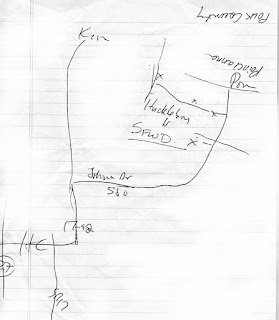
submitted by Donna Bollenbach, Suncoast Chapter (originally printed in The Grapevine, the Suncoast Chapter's  monthly newsletter) The Map The Map Back in October, I ran into a friend at a native plant talk. He enthusiastically told me about a colony of Celestial Lilies, Nemastylis floridana , that were blooming in central Florida, and hastily drew me a map to locate the beautiful and endangered wildflowers. The map was very rough, so I tried to ask questions, but the talk we were both attending started, and I was left with this somewhat cryptic diagram. In any case, that weekend my husband, Bob, and I decided we were going to try find the spot, and invited a few unsuspecting friends for the hunt. I first tried to see Celestial Lilies at Kissimmee Prairie Preserve. It was late fall, a little pass their peak blooming time, and all we found was one bud. With at least six pairs of eyes staring at it, it did not open. I should also say that Celestial Lilies are unusual in ...

DON'T CUT DOWN THAT SNAG

Image
Submitted by Donna Bollenbach Courtesy of Wikimedia  The Wildlife Tree SNAGS, often referred to as “The Wildlife Tree”, are dead tree trunks that are still standing. They provide perches, food and nesting sites for birds and other wildlife. Wildlife also uses dead wood as landmarks for navigation, basking platforms, perching and nesting. Cavity Dwellers Nearly 40 species of birds and several species mammals in Florida nest in tree cavities.Woodpeckers, are a “primary excavators.” Owls, Blue-birds, Squirrels and Nuthatches are a few of the “secondary cavity users.” Photo by Donna Bollenbach Snags as Perches Many birds perch high on snags so they can spot prey below. Some birds perch on snags for the greater visibility to a potential mate. Snags as Cover Birds and small mammals take shelter in the cavities of trees Bees may also create hives in tree cavities. Snags for Nesting Ospreys and eag...

Wildflower Portraits: 10 Tips for Taking Great Close-up Images of Native Plants

Image
Submitted by Donna Bollenbach, Suncoast Chapter / Nature Photographer Taking great close-up images of wildflowers is no different than taking great photographs of people, except the wildflowers won’t ever tell you they look “too fat” or “too old” or “too plain.” But, like people portraits, there are a few tips to taking outstanding wildflower portraits: 1. Get close, but be mindful: If it is the flower you are after, get as close as you can without damaging the plant or the habitat. If you want people to be able to identify a plant from your image, be sure to include features that are unique to the species, such as leaves, fruits or seeds. Celestial Lily,  Nemastylis floridana , a rare endemic. 2. Be level: The closer you are to a subject, the less depth-of-field you will achieve. So, position your camera so the lens is parallel with the flower, or other feature of the plant, that you want to be the sharpest. If you have a depth of field preview on your ...

October is Florida Native Plant Month, and a great time to buy natives…

Image
by Donna Bollenbach, Suncoast Chapter Originally published in part in the Plant City Observer to promote Florida Native Plant Month and the Suncoast Native Plant Society Fall Plant Sale.   For the second year in a row, The Hillsborough County Board of Commissioners and the Mayor of Tampa have officially proclaimed October as “ Florida Native Plant Month .” The Florida Native Plant Society (FNPS) chose the month of October because, while many states have stunning displays of spring flowers, Florida’s mild climate provides for a spectacular showcase of native flowers and grasses in the fall as well. Additionally, with a slight drop in the temperature, October is the month when many Floridians escape the confines of their air-conditioned home to visit our wonderful parks and preserves, or to work in their gardens. October is also the month that the many chapters of the  Florida Native Plant Society   holds native plant sales. The Suncoas...

Keeping a Nature Journal: Understanding your environment through observation, writing and drawing.

Image
Submitted by Donna Bollenbach. Journal Drawings by Marjorie Shropshire There is no better way to connect with nature than by keeping a nature journal: a collection of observations, interpretations and feelings that describe or illustrate your personal view of the natural world. Nature journals are most commonly in the form of writing, drawing or photographs, or a combination of these.  Nature Journaling is rewarding for both children and adults. It is a great a learning tool, as well as a way to develop a deeper understanding and appreciation of nature by recording and sharing memories. What is a Nature Journal?  Marjorie Shropshire, 2012 A Nature Journal is a personal record, but it is not a diary. A diary is generally about you and your relationships to other people, while a Nature Journal is about your relationship to the natural world-animals, plants, seasons and climates. While you may not want anyone to read your diary, many people enjoy sharing thei...