Posts

Showing posts with the label economics of native plants

Coccoloba Chapter @ Lowes

Image
Back row: Mark Miller, Pat Moyer, Lowe's employee Sandra; front row: Suzy Callanan and Barbara Wallace. This was a fun event on Saturday, July 5th from 10am-2pm at Lowe's in Estero (southwest Florida).  Coccoloba Chapter representatives, along with UF/IFAS Lee County Master Gardeners, set up a table at Lowe's on Corkscrew Road to explain the importance of native plants, low-impact landscaping, Lee County fertilizer ban, etc. The morning started off rather busy.  The local News-Press ran an article informing readers the volunteers would be at the store to answer gardening questions.  Several customers indicated they came to Lowe's just to talk to volunteers and get information!  One man walked in with a list of questions on a small sheet of paper explaining that his wife sent him down.  When they saw the Slime Monster poster several commented they had seen the commercials and enjoyed them.  One gentleman was really happy (somewhat stunned) to see the ...
Join the Blog Team

Image
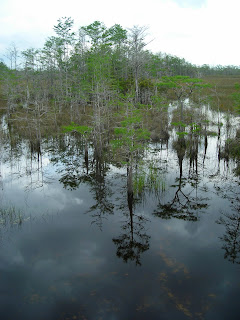
 Cypress head at Grassy Waters Preserve         Shock and awe would just about describe the feeling I had yesterday as I came across a brand new shopping center here in Virginia which had to cover,  in a conservative estimate, about 30 acres. Imagine  it - 30 acres completely covered by parking and buildings without a single plant or pervious surface of any kind .  I mean not one! With all we know now about best practices. And I had to wonder: why are people surprised that heavy rains have made rivers here overflow, causing massive damage to property and life. Homes are flooded, cars have been swept away, waste water treatment plant overflows have caused campgrounds on rivers to be closed. Stormwater runoff. I think we talk about it more in Florida than some other states do. But it’s a concept that everybody needs to understand. We can’t always have what we want! We have to pay attention to the changes we are making to our environment, ch...

Systems, Lifestyle, Imagination: Designing Gardens With Rick Darke

Image
When Rick Darke approaches a landscaping project, he doesn’t begin by telling anyone to start planting natives. Instead, he approaches his projects – ranging in size from miles of area along Delaware’s highways to a quarter acre home in Florida – by focusing on lifestyle, ethics, and systems. I caught up with Rick while he was aboard a train headed for one of his many presentations, this one at the Pratt Institute in Brooklyn entitled: T he Art of Observation:  Finding The Extraordinary In The Ordinary Landscape . Our call dropped five times, but Rick’s passion for creative, ecologically sound gardening could not be intercepted by a wireless signal! Rick’s frustration with pushing native plants from a purely moral perspective came through loud and clear: “ I am loathe to constantly talk about native plants out of context. I talk about a system. We really have to understand systems, dynamics, intervening vegetative dynamics... We have to teach people to see the wonder of ...

Economics in the Native Plant Industry

Image
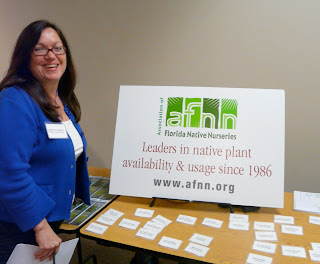
Cammie Donaldson, Executive Director The 25th anniversary year of the Association of the Florida Native Nurseries (AFNN)  started out with a bang last Saturday,  when forty one participants from all over the state traveled to Kissimmee to participate in a workshop: Economics and Ecotypes. The group represented a mix of growers, retailers, landscape professionals, municipal reps, and Florida Native Plant Society (FNPS) members who spent the day in intense, active learning about current conditions influencing the commercial native plant sales industry today. Seven professors from the University of Florida  gave excellent presentations and led stimulating discussions.  Dr. Alan Hodges, an economist intimately familiar with the native plant industry, said the good news is that the economy is growing again, albeit slowly and with a bit of bouncing. However, it seems possible to many that we are experiencing a fundamental change in the human condition. Because te...