Posts

Showing posts with the label florida native wildflowers

Wednesday's Wildflower: Southern Beeblossom, Oenothera simulans

Image
Submitted by Jean Evoy, a 30-year veteran of FNPS. She has been active in several chapters including Miami-Dade, Serenoa, and Mangrove. Southern Bee Blossom flower, photo by Jean Evoy Southern Beeblossom is a common wildflower of roadsides, fields, dunes and open woods in Florida.  It used to be called Gaura angustifolia , but a few years ago the evening primrose family underwent extensive revisions and G. angustifolia , was renamed Oenothera simulans along with several other species of that were included in the genus Gaura. Crimson moth larva, J Evoy Southern Beeblossom has slender, branched, hairy stems that may reach six feet. The leaves are reduced on the upper parts of the plant and tiny flowers are found near the ends of wand-like stems. The flowers are white when they open in the evening.    They become pinkish the following day before withering.   As the name beeblossom indicates, the flowers are attractive to many insects, including be...

Wednesday’s Wildflower: American White Water Lily

Image
Nymphaea odorata Submitted by Lynn Sweetay, Palm Beach Chapter White Water Lilies, Linda Sweetay, Palm Beach County  One of my very favorite wild flowers is Nymphaea odorata, commonly known as the American White Water Lily.  As the name suggests this is a floating aquatic plant (Nymphaea = water sprite; odorata =fragrance) with large, fragrant, white or pink flowers and flat, round, floating leaves.  The leaves are bright green above and purplish beneath.  It is native to Eastern North America from Florida to Canada .  It can be found in still shallow water (5-7 ft deep) with mucky bottoms. The flowers open in the morning and remain open until around noon .  There is one flower to a stem, each flower is 2 to 6 inches wide with many rows of white petals.  Petals are ¾ to 4 inches long and pointed at the tip. There can be more than 25 petals to one flower! White Water Lilies, Linda Sweetay, Palm Beach County  ...

Wednesday Wildflowers: Sundial and Skyblue Lupines

Image
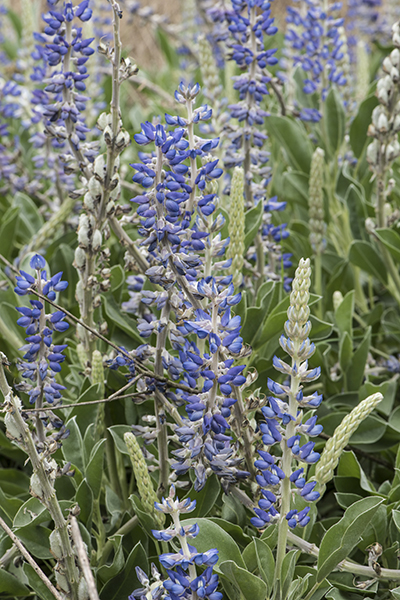
Today's Wednesday's Wildflower features two species of Lupine, the Sandhill Lupine, submitted by Roger Hammer, and the Sundial Lupine, submitted by Bill Berthet. Edited by Valerie Anderson. Sandhill Lupine,  Lupinus cumulicola                                                          Text and photo by Roger Hammer, Dade Chapter Sandhill Lupine, Lupinus cumulicola , by Roger Hammer From January to May each year the white sand scrub on the Lake Wales Ridge in Lake, Osceola, Polk, and Highlands Counties are adorned with the cheery blue flowers of the Florida endemic skyblue lupine (pronounced LOO-PIN). Some botanists consider it a synonym of Lupinus diffusus but others argue that L. diffusus differs by its habitat, range, prostrate to decumbent stems, orbicular-reniform (kidney-shaped) standard, and a nearly straight beak on ...

My Quest for Milkweeds

Image
Story and photos by Janet Bowers, Suncoast Chapter of the Florida Native Plant Society At the beginning of my ‘Natives’ life, I learned a lot from working on the plant sale plant profiles, so I thought the only milkweeds in our area were Asclepias incarnata , A. tuberosa and A. perennis . Apparently those are the ones that nurseries have grown for a while. If I had known better, I might have checked out the USF Plant Atlas where I could have looked up genus Asclepias and would have seen that there are many more species in our area.  Butterflyweed,   Asclepias tuberosa, Lake Blue Scrub I have seen 9 milkweed species so far this year in relative proximity to our area, and I have now done the USF Plant Atlas search so I know there are more out there. An advance search in Hillsborough County lists twelve species.Oddly enough (at least to me), two of the species I have never seen in the wild are the swamp milkweeds that we sell at our plant sale. They are at the top...

2015 FNPS conference: Native Yard Tour

Image
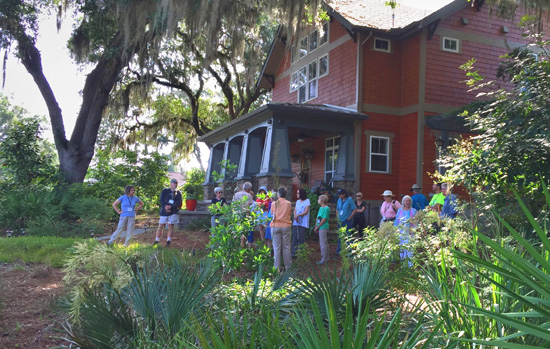
A conference field trip by Donna Legare with photos by Lilly Anderson-Messec On Thursday, May 28th Native Nurseries led a tour of native yards in Tallahassee for the Florida Native Plant Society's 35th Annual Conference. The tour featured three yards. 1) A rain garden and more... The first illustrated what could be done with a blank slate in a neighborhood that was previously a cow pasture with scattered large live oaks. Landscape designer, David Copps designed the native landscape for Mark and Linda Powell, whose home is certified as LEED Platinum. The native landscape helped them earn this designation. David described how he implemented his design, beginning with very heavy mulching of existing vegetation. He included a rain garden in a natural depression and created a future forest of mixed hardwoods in one section and a small longleaf pine grove in the back yard. Jody Walthall, owner and landscape designer at Native Nurseries talked about what is involved in mainta...

Study: Roadside Vegetation Can Provide $1.5 BILLION in Ecosystem Services

Image
A recently released Florida Department of Transportation study conservatively estimates that roadside vegetation along the state highway system performs nearly a half-billion dollars worth of ecosystem services. The study found that value would increase to $1 billion if sustainable vegetation management practices such as reduced mowing were adopted. The value would triple to $1.5 billion if wildflower areas were incorporated into roadside landscapes. Ecosystem services include carbon sequestration, runoff prevention, and support of crop pollinators and other insects, as well as contributions to air quality, invasive species resistance and roadside aesthetics. Native roadside wildflowers in Florida's Panhandle The Florida Wildflower Foundation requested the Florida Department of Transportation study on behalf of the Florida Native Plant Partnership, which includes the foundation, Florida Association of Native Nurseries, Florida Native Plant Society, and Florida Wildflower Pla...

Good News for Florida's Roadside Wildflowers!

Image
By Lisa Roberts Florida Wildflower Foundation Executive Director Florida Department of Transportation Secretary Ananth Prasad recently signed the department's new Wildflower Management Program Procedure , which will allow more of the state's native wildflowers to flourish along roadsides through reduced mowing and other management practices. Left to right - Jeff Caster, FDOT landscape architect; Jeff Norcini, FDOT wildflower horticulturalist; FDOT Sec. Ananth Prasad; Florida Wildflower Foundation liaison Eleanor Dietrich FDOT state transportation landscape architect Jeff Caster said, “Roadsides are the state’s most visited and visible landscape.  The department is committed to increasing the visibility and enjoyment of native wildflowers.”  State Road 65 - roadside wildflowers; photo by Eleanor Dietrich "We salute the department in enacting this forward-thinking program," said Vince Lamb, Florida Wildflower Foundation board chairman. "In Flor...

Apply for Grants and Awards

Image
Do you have a pet native plant project that needs recognition or some funds to get it off the ground? Now is the time to apply... Native Plant grants FNPS is inviting researchers on Florida native plants to apply for small grants to support their research.  Research grant applications are granted on the basis of importance to the protection, preservation and restoration of Florida native plants and subject to funds availability.  The deadline for the 2013 grant cycle is March 1, 2013.  For more information on the grants and submittal process, please view and download the award application .  For examples of past grant recipients, please see: http://fnps.org/what-we-do/research . Native Plant Conservation Grants FNPS invites you to apply for a Florida Native Plant Conservation Grant. When funding is available, grants will be awarded to applied plant conservation projects that will promote the preservation, conservation, restoration, and/or protection of F...

FNPS Ixia Chapter Project: Native Park Restoration

Image
The City of Jacksonville’s Native Park, located at 3312 Park Street in the Riverside Avondale Historic District, was established by the Avondale Garden Circle in 1923. The purpose was to increase public awareness of plants indigenous to north Florida and demonstrate that, while exotic species often died during adversity, the Park’s native plants prospered with little care through drought, freeze, and hurricane. During the nearly 90 years that have passed since that time, the Park became a tangle of invasive exotics and overly vigorous natives. Native Park was adopted in 2010 by the Ixia Chapter of the Florida Native Plant Society as part of the City's Friends of the Park program to carry out the Park's original purpose and to advance the mission of the Florida Native Plant Society.  The signs identify the various native plants.  After many Saturday mornings spent digging up vast amounts of invasive and other non-desirable plants, Chapter members and other vo...

Keyhole Garden In - Lawn Out

Image
"I didn't want grass anymore, and I didn't want a yard that looked just like everybody else's," says Diane Neill, explaining how she came to be the proud owner of this beautiful garden.  "I was interested in conserving water, tired of mowing and feeding the turfgrass, and wanted to get more enjoyment out of my outside space." Keyhole garden shortly after installation Diane knew nothing about native plants, or even about garden design; but serendipitously, her son, Brandon, who just graduated with a major in Sustainable Living, came home last spring from Iowa with lots of ideas and some awe-inspiring garden design books. He had been learning  about using planting beds, and suggested those as good alternative. Diane was intrigued with the pictures, and excited about combining flowers with edibles and herbs, but had some reservations: what would the neighbors think? Would the HOA allow it? She definitely wanted something that looked attractive and woul...