Posts

Showing posts with the label mangroves

Paddling with Skeletons

Image
Paddling with Skeletons Shirley Denton Twice in the last two months, I have joined friends on multi-day paddling trips in southern Florida. The first (in late December, 2017) was to the shoreline southeast of Goodland.  We were in the area in the quadrant of the storm with the strongest on-shore winds. The second was the Florida Keys near Big Pine Island in April, 2018. We paddled at Cudjoe Key where the eye of Hurricane Irma passed over the Florida Keys and 6 other places the quadrant of the storm with the strongest winds up to Marathon.  Just this week, this week (April 17), several preliminary reports from NASA on Hurricane Irma damage in the Everglades were released, so it seems like a good time to share some general observations with you. On both trips, I was particularly interested in the hurricane damage, variation in degree of damage, and in any signs of recovery. Some things were apparent: red and black mangroves in the Keys appeared to have s...

Good Plants Gone Bad

Image
By Shirley Denton We bemoan the prevalence of invasive species in our landscapes. From cogon grass to Brazilian pepper and Japanese honeysuckle, we don’t want them. I personally fight with natal grass, guinnea grass, skunk vine, and lantana, all of which insist on coming into my landscape. But I love species such as water lily and red mangrove – and sometimes us humans have spread them beyond their native ranges. I thought it might be instructive to see how some of them have behaved in their new homes. Global Invasive Species database I just scanned through 3065 records in the Global Invasive Species database looking for Florida natives that can misbehave when moved into areas where they don’t grow natively. I found a dozen of them, but since I was scanning through the list, there could be more. And this is just the species that are considered to be problems in the areas where they are introduced. Some of these I knew about. Others were surprises. A couple, I didn’t even know ...

Shoreline Restoration and Habitat Creation in Palm Beach County

Image
The Snook Island project, a public/private restoration in Palm Beach County, was dedicated on November 2, 2012.  This project includes, planting mangroves, spartina grass, and other native plants on the shoreline and on islands and jetties built with rubble from the old drawbridge here. Some of it had been left in place after the new bridge was built and had been used for many years as a fishing pier, but it had become unsafe. So instead of transporting the spoils to a landfill, the cement blocks were used to create the substrate for the plantings and as an artificial reef for the new fishing pier. Other niceties included here are the benches, a boardwalk along the mangroves for the birdwatchers, a launch platform for kayaks and canoes, water taxi docking stations, and reconfigured parking for the trailers. So now instead of a rotting cement bridge and an eroding shoreline of the public golf course, the local residents have a beautiful recreational resource...

Florida’s Mangroves: A Cross-family Comparison

Image
By Lily Everson and Kara Cecil This post is one of a series from professor Nisse Goldberg's Plant Taxonomy students at Jacksonville University. FNPS blogger Laurie Sheldon assisted the students with their initial drafts, providing suggestions for editing and content development. Overview Mangroves are tropical trees that can grow well in both fresh and brackish water. There are four main species of mangroves in Florida: the red mangrove ( Rhizophora mangle , Fig. 2), the black mangrove ( Avicennia germinans , Fig. 3), the white mangrove ( Laguncularia racemosa , Fig. 4), and buttonwood ( Conocarpus erectus ). This article will focus on the red, black, and white mangrove species . Figure 1. Mangrove zonation. Mangroves are traditionally found on the coasts of Florida as far north as St. Augustine. With the warming of temperatures, the mangroves have been spreading northward into salt marsh habitats dominated by Spartina alterniflora . This has become a topic of intere...

Shoreline Habitat in the Intracoastal Waterway

Image
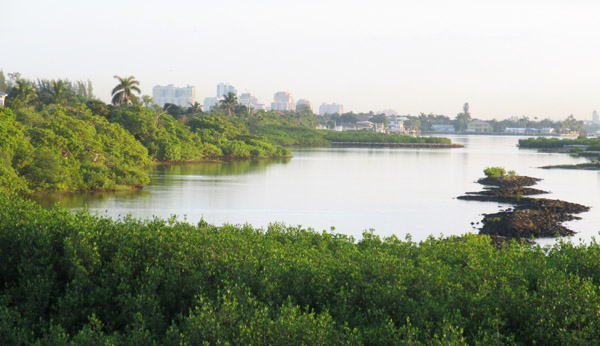
New islands and pennisulas have been constructed and planted with mangroves and cord grass in Lake Worth (Palm Beach County, FL). The foliage in the foreground is the mangroves that were planted several years ago. On the right side, the curvy island has been added and planted this year. On the left side note the shoreline vegetation next to the golf course. West Palm Beach is in the background. Up until a few years ago, the wakes of passing boats in the Intracoastal Waterway lapped up against the bare shoreline and seawall of the public golf course and the adjacent Bryant Park without any interferance. Now in several areas, where new living shorelines* have been installed, the wakes don't hit the seawall at all, but are absorbed by the new mangrove-covered extenstions to the seawall and new islands. Several areas of cord grass ( Spartina spp ) have also been planted. There are 10 acres of mangrove and nearly 3 acreas of cord grass.  In this phase of the p...

Florida's Marvelous Mangroves

Image
Too many native mangrove stands have been removed from the edges of Florida's waterways over decades of development, and as a result shorelines are more vulnerable to tropical storms and our native bird and fish populations are in steep decline. Mangroves growing in thickets along tropical and sub-tropical shorelines absorb the wave action from open waters, build new land as they slow down and hold onto passing sediment, and create fabulous habitat for many types of wildlife. Many types of birds inhabit mangrove thickets and some of them are endangered or have declining populations. Some examples are roseate spoonbills, limpkins, white ibis, herons, bitterns, anhingas, osprey, peregrine falcons, and bald eagles. Mangroves are so important for the health of the shorelines that Florida has passed regulations to govern their treatment.  We mentioned mangroves last week as one of Florida's important water resources and habitats in We ALL Live in a Watershed! Mangroves as far ...