Posts

Showing posts with the label habitat landscaping

DON'T CUT DOWN THAT SNAG

Image
Submitted by Donna Bollenbach Courtesy of Wikimedia  The Wildlife Tree SNAGS, often referred to as “The Wildlife Tree”, are dead tree trunks that are still standing. They provide perches, food and nesting sites for birds and other wildlife. Wildlife also uses dead wood as landmarks for navigation, basking platforms, perching and nesting. Cavity Dwellers Nearly 40 species of birds and several species mammals in Florida nest in tree cavities.Woodpeckers, are a “primary excavators.” Owls, Blue-birds, Squirrels and Nuthatches are a few of the “secondary cavity users.” Photo by Donna Bollenbach Snags as Perches Many birds perch high on snags so they can spot prey below. Some birds perch on snags for the greater visibility to a potential mate. Snags as Cover Birds and small mammals take shelter in the cavities of trees Bees may also create hives in tree cavities. Snags for Nesting Ospreys and eag...

Planting a Feast for Nature

Image
By Marlene Rodak Creating Bird and Butterfly Habitat at Middle School A tiny butterfly on bloodberry ( Cordia globosa ), which is one of the native species that will be planted at Fort Myers Middle Academy on Tuesday   The school corridor to be planted A spectacular event will take place the morning of Tuesday, July 28 at Fort Myers Middle Academy.  Florida Forest Service employees and volunteers from the Florida Native Plant Society are planting hundreds of native plants in an outdoor corridor, which will transform the area into important bird and butterfly habitat.  This planting will demonstrate how natural, native landscaping functions in the environment by providing food and shelter to wildlife.  Best of all, the entire project is provided to Fort Myers Middle Academy and Lee County Schools FREE OF CHARGE! FNPS Coccoloba Chapter President Martha Grattan shoveling mulch at Fort Myers Middle Academy Florida Native Plant Society is c...

Plant a native tree to celebrate Florida's Arbor Day!

Image
Pileated woodpeckers work a red bay ( (Persea borbonia ) before it was killed by the laurel wilt disease. Trees are so important! And to receive the maximum benefits with the least amount of effort, plant a tree native to your region and one that's been bred from local stock.  Here is a post to help with this: Natives for your landscape: an FNPS tool for you . In addition to being beautiful and supporting local wildlife, here are a few of the more quantifiable benefits.   Trees: - clean the air. In 1991, Chicago's 51 million trees “removed an estimated 17 tons of carbon monoxide, 93 tons of sulfur dioxide, 98 tons of nitrogen dioxide, 210 tons of ozone, and 234 tons of particulate matter. They [also] sequestered about 155,000 tons of carbon. ... where trees were large and lush, they could improve air quality by as much as 15 percent during the hottest hours of midday. More trees and bigger trees meant cleaner air." ( What Is a Tree Worth ) - absorb wat...

Christmas is for the birds

Image
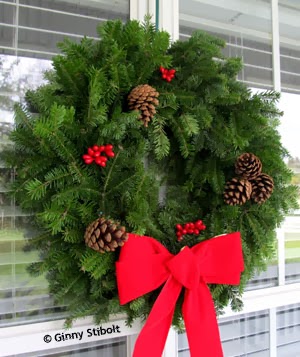
My daughter sends a wreath to all the family members each year. They are perfectly fine wreaths that are part of a local fund raiser in her community.  This year it is a full spruce wreath with a bow, some pinecones and plastic red berries that you can stick in the wreath--a product of Nova Scotia.  I wrote about how I make my own wreaths in The Recycled Wreath  to supplement her yearly gift. And each year I feel bad for the small birds that are attracted to those fake berries. So this year I decided to take action and I added cranberry chains to both the original wreath and the recycled ones so the birds will find something to eat. The fake berries are still there, but they now hold up the cranberry chain. I also added various seed heads to the original wreath. So now all of my wreaths are bird-friendly. For more on making wreaths using native plants see Sue Dingwell's post from a few years back: Native plant wreath making .  Original wreath So this is what ...

When I bought a cottage...

Image
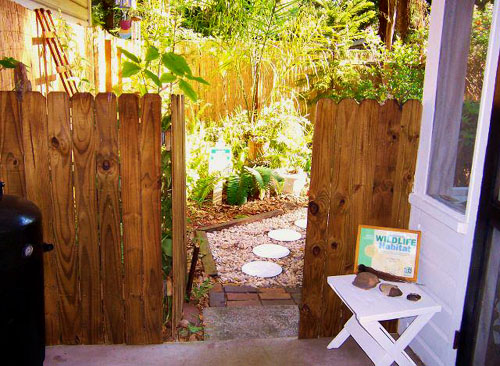
by Bill Belleville When I bought a cottage-style home at the edge of the historic district in Sanford some seven years ago, I was happy with the large double lot and the magnificent live oak trees. Sanford was a real old-fashioned town with a real old-fashioned spirit, and I cherished it. Wooden gate I installed, along with wooden fence around entire backyard, not long after I first moved into Sanford on the edge of the historic district. Had just left 15 good years of living out in what had once been the country, and I yearned to revitalize some of the "wildness" I had known there. What was less attractive, though, was the monoculture of St. Augustine that ruled the back yard. It stretched across my property like a giant green shag carpet---an obsessively tailored rug that met and merged with my neighbors’ own grassy decor. As a guy who writes about nature and conservation, I was well acquainted with the damage this sort of “yard” could do to both the quality and ...

Native Plant Myth Number One

Image
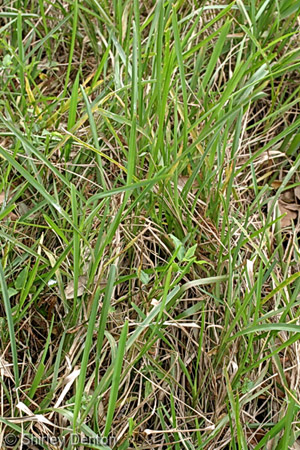
by Shirley Denton Have you ever read a newspaper article or website that makes a statement like this: "Planting natives will save water."? This is an example of a native plant myth. Most myths, including this one, come from broad generalizations that are only sometimes true. Likewise, the converse, "planting non-natives will waste water" is a broad generalization that is not always true either. This article covers this myth, and future blog posts will address some others. Stay tuned... Florida's varied ecosystems Florida has a broad range of native ecosystems that support characteristic plant communities. We have rosemary and sand pine scrubs and sandhills (very dry), we have flatwoods (moderately wet to moderately dry), we have hammocks (some wet, some dry), we have wetlands such as swamps (very wet), and a long list of other ecosystems. A good summary of these and others is found on the FNPS website resource article: Native Plant Communities . ...

Man-in-the-Ground

Image
Man-in-the-ground ( Ipomoea microdactyla ), fantastically beautiful morning glory for southernmost Florida. A post by Roger L. Hammer Most everyone is familiar with morning-glories in the genus Ipomoea, and certainly everyone reading this has even eaten Ipomoea batatas, the common sweet potato. The Morning-Glory Family (Convolvulaceae) is well-represented in Florida, with 67 species in fourteen genera. Of those, twenty-four species are naturalized exotics, and four species are endemic to Florida, found nowhere else. The genus Ipomoea is the largest in the family, with twenty-five species and one naturally-occurring hybrid of two native species. Exactly half of the species (13) in Florida are native. Only two species are rare enough to be listed as endangered by the state of Florida, and these are the rockland morning-glory ( Ipomoea tenuissima ) and man-in-the-ground ( Ipomoea microdactyla ). Both are on the northern extreme of their natural range in Florida, and both are re...

Plant Profile: Crossvine (Bignonia capreolata)

Image
Figure 1. Bignonia capreolata , note the tubular flowers and two opposite leaves. Photo credit: Stan Shebs http://en.wikipedia.org/wiki/ File:Bignonia_capreolata_1.jpg This post is one of a series from Botany professor Nisse Goldberg's students at Jacksonville University. Student author: Rebecca Clark Common Name: Crossvine Scientific Name: Bignonia capreloata L. Bignonia capreolata or crossvine belongs to the Bignonia family and is found throughout the central to northern parts of the state. It is a woody, semi-evergreen vine, or liana, that can grow to be as long as 50 feet, using tendrils to attach to surfaces. Crossvine is found in forests, swamps, hammocks, fencerows, and limestone escarpments. Crossvine is a relatively low-maintenance plant. The plant has low to medium water needs and is drought tolerant. It does do well in moist, well-drained, and acidic soil but can tolerate other soil conditions. The best flowering occurs in full sun even though the plant can...

Trumpet Vine (Campsis radicans) Profile

Image
Figure 1. Trumpet vine flowers. Photo credit: Stan Shebs taken at the Desert Demonstration Garden in Las Vegas, Nevada, May 2003 This post is one of a series from Botany professor Nisse Goldberg's students at Jacksonville University. Student author: Tayler Massey The trumpet vine, otherwise known as Campsis radicans , is a plant you’ve probably seen many times and don’t even realize you’ve seen it! The trumpet vine is a native plant to Florida, but can also be found in many areas throughout the eastern, southeastern, and southwestern parts of the United States. The plant can survive at any time during the year, if it is given the right conditions to grow. The trumpet vine grows best in coarse to medium grain soils with neutral pH levels. So long as the soil remains moist, the trumpet vine does not need an abundance of water, but it does need a great deal of sunlight. It is best if planted in the open rather than in the shade. Once established the trumpet vine is very tol...

Orange Lake Native and Exotic Flora Activities

Image
By Buford C. Pruitt, Jr. In the summer of 2010, I approached Florida environmental agency staff at a Little Orange Creek Working Group meeting about volunteering to cut down and poison several species of invasive exotic trees (paper mulberry, Chinaberry, and Chinese tallow) that had colonized four spoil islands within the marshland in McIntosh Cove on the west side of Orange Lake. I also wanted to transplant from my yard some volunteer seedlings of black cherry, sweetgum, live oak, sugarberry, and cabbage palm in order to provide competition to discourage the three Chinese exotics from re-invading. I also wanted to provide some forested habitat on the islands that might possibly be used for nesting by the lake’s water birds. Florida Fish and Wildlife Conservation Commission staff member Bruce Jaggers responded that the spoil islands were a byproduct of FWC’s effort to scrape down muck sediments from an adjacent area of Orange Lake. This would expose sandier sediments that would provid...

Shoreline Habitat in the Intracoastal Waterway

Image
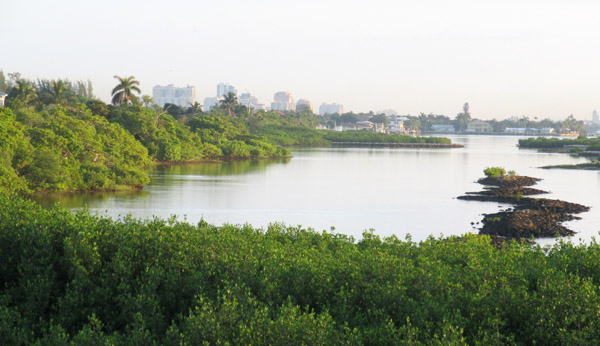
New islands and pennisulas have been constructed and planted with mangroves and cord grass in Lake Worth (Palm Beach County, FL). The foliage in the foreground is the mangroves that were planted several years ago. On the right side, the curvy island has been added and planted this year. On the left side note the shoreline vegetation next to the golf course. West Palm Beach is in the background. Up until a few years ago, the wakes of passing boats in the Intracoastal Waterway lapped up against the bare shoreline and seawall of the public golf course and the adjacent Bryant Park without any interferance. Now in several areas, where new living shorelines* have been installed, the wakes don't hit the seawall at all, but are absorbed by the new mangrove-covered extenstions to the seawall and new islands. Several areas of cord grass ( Spartina spp ) have also been planted. There are 10 acres of mangrove and nearly 3 acreas of cord grass.  In this phase of the p...

A Walk In the Longleaf Pines

Image
Happy New Year to ALL!  Enjoy this piece by Eleanor Sommers, a member of the Paynes Prairie Chapter. If you or your chapter has a story to tell that includes something about Florida native plants, let us know. We'd love to host more guest bloggers. Email us at fnps.online@gmail.com with your ideas and plant some Florida native plants to celebrate 2011.   Ginny & Sue A Walk along a Longleaf Pine Trail If you haven’t explored the Longleaf Ecology and Forestry Society’s (LEAFS) trails in eastern Alachua County near Waldo consider doing so next time you are in the area. This private demonstration project has been designed to show small private landowners (100 acres or less) how to “harmoniously and profitably” restore and sustain a longleaf pine ( Pinus palustris ) habitat using fire, selective harvesting, and replanting of desired species. Once reestablished, the habitat can be “maintained and utilized for the production of forestry products (LEAFS brochure)...