Posts

Showing posts with the label native landscape

Bank with Natives in Steinhatchee by Jaya Milam

Image
Big Bend Chapter completed a native plant conversion for our local Citizens State Bank .  We transformed the garden beds from all non-native to all native ! The bank's managers were delighted with the results. They were very pleased to know that there is very low maintenance and the garden beds will shine with natural beauty most of the year! Through this project we were able to share much information regarding the quality and sustainability of going native with many in our community that go past our beautiful Native transformations and get to enjoy the natural beauty.  We were provided the privilege to put our Big Bend Chapter Sign discretely in the corner of each flower bed to encourage folks to consider native when gardening at their home or business facility.  We have received numerous compliments and commendations from many customers and folks just passing by....Go Native, it’s contagious!

Short Plants in Sun: Natives for Urban Gardens

Image
Submitted by Richard Brownscombe Reprinted with permission from the April newsletter of the Broward County Chapter of the Florida Native Plant Society  Plants under a foot high are very useful in the urban garden. You can avoid mulch if there are enough small plants to outcompete the weeds. Short native species may be the most interesting in a landscape because they are underutilized and seldom seen. All of the species below prefer full sun and are native to Broward County. Let's jump right into looking at a few species for drier soils and then a few more for average-moisture soils. Sun/Drier Soils We have identified four species for places in your landscape of Sun and Drier Soils. Sun means at least 6 hours including the hot midday sun. All drought-tolerant plants need water, but have evolved ways to retain it or roots to reach for it. Generally, well-drained sandy soils are suitable for these scrub species. Give them deep watering until the roots take hold. Wilting leave...

DON'T CUT DOWN THAT SNAG

Image
Submitted by Donna Bollenbach Courtesy of Wikimedia  The Wildlife Tree SNAGS, often referred to as “The Wildlife Tree”, are dead tree trunks that are still standing. They provide perches, food and nesting sites for birds and other wildlife. Wildlife also uses dead wood as landmarks for navigation, basking platforms, perching and nesting. Cavity Dwellers Nearly 40 species of birds and several species mammals in Florida nest in tree cavities.Woodpeckers, are a “primary excavators.” Owls, Blue-birds, Squirrels and Nuthatches are a few of the “secondary cavity users.” Photo by Donna Bollenbach Snags as Perches Many birds perch high on snags so they can spot prey below. Some birds perch on snags for the greater visibility to a potential mate. Snags as Cover Birds and small mammals take shelter in the cavities of trees Bees may also create hives in tree cavities. Snags for Nesting Ospreys and eag...

Find your "AWESOME" on a Conference Landscape Tour

Image
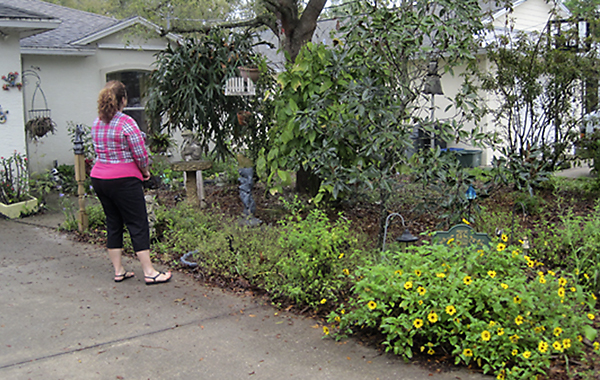
Submitted by Sonya Guidry The Pawpaw Chapter of the Florida Native Plant Society recently held a South Volusia Landscape Tour that included many of the native landscapes  that will be featured on FNPS Conference Fieldtrip "K" Landscape Bus Tour on Thursday, May 19th. They ended their yard tours at the Marine Discovery Center , the location for the  Kayak (paddle) - Lagoon Restoration Tour , FNPS Conference Fieldtrip"I" ,  on Thursday, May 19th.  Here is a glimpse of some of the  tour's native yards, and the Marine Discovery Center... Renee Luedke's Port Orange home.   Surprise, her front yard has no grass to mow!   Elizabeth ponders the diversity of plants in Renee's front yard. Most of the 16 tour visitors are gathered around Renee as she talks about her landscape.   Mike visiting from the UK notes Renee's creative bird feeders... including the log filled with peanut butter suet. Elizabeth Flynn will be ...

Add Native Plants to Your Landscape

Image
by Donna Bollenbach A few years ago my parents decided that they could no longer keep up with the maintenance of their home. They moved in with my sister, and asked my husband and I if we would like to live in their house. As we were between homes, we accepted. The move from a country home on a two wooded acres to a suburban home on a 1/3-acre lot with a tropical landscape was quite a change for us. We missed our native trees and shrubs and all the wildlife they attracted. The tropical vegetation was pretty, but had very little attraction for the wildlife.   We joined the Florida Native Plant Society Shortly after moving, we joined the Suncoast Native Plant Society . We learned that the native plants we took for granted in our rural home attracted more wildlife because they preferred natives for food and shelter. In our rural landscape we had very little grass, but lots of oaks, longleaf pines, beautyberry, firebush, pokeweed, dewberry, holly, sweetbay, Caroli...