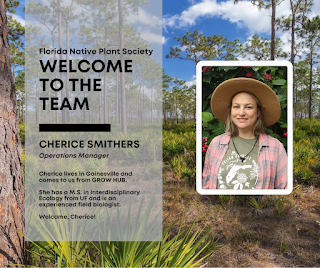
By Laurie
Sheldon, newest member of the F.N.P.S. blog team
Introduction
As
a follower of the FNPS blog, it’s a given that you’re interested and/or
enthusiastic about Florida’s native flora. You can probably recall a dozen or
so trips to a local nursery, where you walked between row after row of plants
in black pots and imagined how they would look in your own landscape. I worked
for several years in a sizable nursery in Miami, so I know the plant-dreamer
look all too well. Admittedly, I was not immune to becoming starry-eyed in the
presence of some outrageously beautiful plants, and frequently came home from
work with one or two random specimens that I just had to have. Needless
to say, my spur-of-the-moment plant shopping did little to enhance the overall
aesthetic of my backyard, and did even less as far as enhancing my wallet was
concerned.
 |
| Lichtenstein at F.T.B.G., a fusion of art and science |
I
left my nursery job and became a “Garden Groomer” (volunteer weed-puller) at
Fairchild Tropical Botanical Gardens, where I was exposed to large-scale
landscape design for the first time, and developed an appreciation of the
diverse, unusual, and brilliant world of tropical plants. After a short while,
I decided that I wanted to design inspirational places like Fairchild
professionally, so I headed to the University of Florida in pursuit of a
Bachelor’s degree in Landscape Architecture.
It
became very apparent to me throughout the five-year L.A. program that, although
our texts were housed in the Fine Arts Library, Landscape Architecture was/is
as much of a science as an art form. The most loved, used and functional
outdoor spaces are not generally arrived upon by mysterious forces or inspired
by muses, nor do they come about via organic accretion. They are the
site-specific products of thoughtful individuals who used a series of steps,
collectively known as the Design Process, to arrive at a final design.
The
Design Process
The
Design Process is systematic,
time-tested, and the only way to consistently identify the optimal arrangement
between that which you’d like to incorporate into a landscape and its existing
natural and constructed features. It is the Landscape Architect’s answer to the
Scientific Method. It dictates that, whether designing a home garden or a
corporate campus, your approach will, at minimum, include the following steps
PRIOR to installation:
1. Statement of Intent
2. Procurement of a Topographic Survey
3. Site Inventory and Analysis
4. Program Development
5. Conceptual Diagramming
6.
Diagram
Selection
7. Master/Site Plan and
Design Development Documents
Once
your plan has been installed, it is always useful to do a Post-Construction
Evaluation, noting whether or not your landscape accomplishes the goals you
initially set out. More often than not, however, this step is skipped in
professional practice - sometimes because a client does not want to pay for a
Landscape Architect to provide a critical analysis of their own work, sometimes
because, well, the laws of inertia and our fast forward pace make it an
impossibility. Either way, once the dust settles, if time allows, it is good
practice to at minimum make note of any discrepancies between the master
landscape plan and the finished work.
 |
Intent, Goals, & Objectives are prominently noted on
this student's submission for a poolside landscape |
|
Step 1: Statement of Intent
The first part of the Design Process
is ideological in nature. It involves determining the scope of your
project, and identifying project goals and objectives.
• Scope is essentially the extent of the
project work to be done, as noted by both physical/measurable boundaries,
and deliverables (what you agree to deliver to your client),
which may include plans for irrigation, grading, planting, etc.
• Goals reflect what you’d like for your
landscape plan to accomplish.
• Objectives identify the
specific tasks you need to complete in order to achieve that goal.
If you're designing your own landscape you probably won't have "deliverables," per se, but you should still determine what your project will and will not cover
before getting started. You’ll be glad you did, as it will keep you focused and prevent you from
biting off more than you can chew.
 |
| Visualizing contours in 3-D |
|
Step 2: Topographic Survey
Topographic
maps in the United States are organized in a grid, and are often referred to as
quads or quadrangles. They typically show bodies of water and land contours,
which are expressed in contiguous (contour) lines. These lines denote altitude
(also called elevation). Every point on a map that a given contour line crosses
is at the same elevation. Once you become familiar with reading topo maps it
will be easy for you to visualize the lay of the land three-dimensionally.
You might
be thinking, “Topography - really?
But our state is so flat - how can it matter?” Florida’s minimal elevation
changes, proximity to the ocean, and high annual rainfall volume combine to
make flooding a serious problem. Knowing
your site’s highs and lows can keep you from having to put on wading pants in
order to fetch your mail.
Another reason that your site’s
topography is important is slope. Slope, the incline between two
topographic contours, is calculated by dividing their vertical difference by
their horizontal difference (rise/run). There are certain optimal slope requirements for various land uses, including playgrounds,
areas to be mowed, sidewalks, stairs, parking, etc. Anyone who has driven out
of state, and had to get a stick-shift car into or out of a hillside parallel
space should appreciate Florida’s maximum and minimum slope standards. I will
elaborate on this in the next blog installment.
 |
| USGS Quad Map |
If you are fortunate enough to have
G.I.S. software on your computer, you can download the appropriate topo map(s)
from the Florida Geographic Data Library, http://www.fgdl.org/download/index.html
A final resource for obtaining a
copy of your project’s topographic survey is your city’s Main Library. These
are generally not permitted to be checked out, so be ready with change for the
copy machine!
Stay tuned for the next installment
of Landscape Design - a Primer. We’ll resume with one of my favorite parts of of the Design Process, Step 3: Site Inventory and
Analysis.