Posts

Conservation and Habitat Restoration for Two Florida Endemic Mints
Image
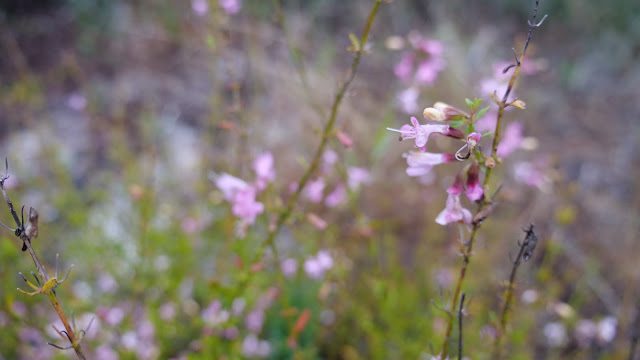
We're proud to announce we were awarded a Powerful Communities Grant from Duke Energy for our Conservation and Habitat Restoration for Two Endangered Mint Species! We're putting it to work by deploying staff and volunteers to monitor two populations of endemic Florida mints. The first rare mint, Blushing Scrub Balm ( Dicerandra modesta ), is endemic to Polk County. The second is Longspurred Balm ( Dicerandra cornutissima ) and is endemic to Marion and Sumter Counties. Both are State and Federally Listed Endangered native plants. We have two main goals: annually monitor these two populations and restore the two sites. The largest and only publicly-protected population of Longspurred Balm occurs on the Marjorie Harris Carr Cross Florida Greenway in Marion County. This population was impacted by the recent construction of an access road. There is only one population of blushing scrub balm on public lands and possibly only one small population remaining on private lands...
TorreyaKeepers Update December 2019

Image
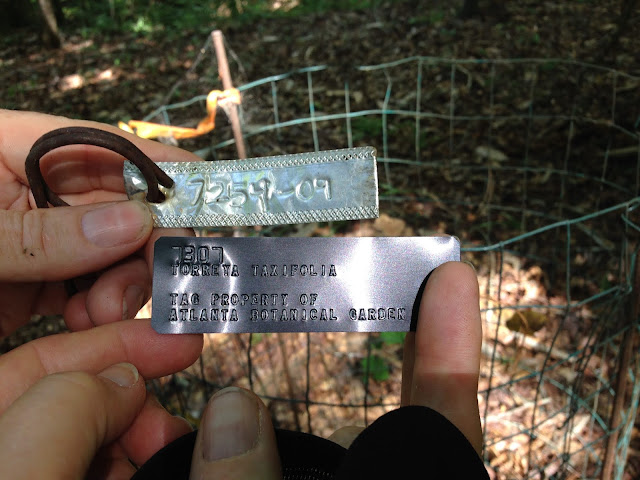
On December 5th, Florida Native Plant Society (FNPS) Executive Director Juliet Rynear joined staff from the Atlanta Botanical Garden (ABG) and volunteers from FNPS, Jacksonville Zoo, and Jacksonville Arboretum to monitor Florida Torreya trees in Torreya State Park , near Bristol. This was just 1 day in a week-long monitoring expedition that takes place annually on public property where this rare tree occurs. The FNPS TorreyaKeepers project is focused on working with private landowners to locate and conserve trees on private property. This project will expand upon the work that ABG is doing and help to conserve more of the genetic diversity of Florida Torreya. Currently, we are working on a brochure to help private landowners identify Florida Torreya and distinguish it from other similar-looking trees. We will also be developing a brochure on best management practices to help private landowners protect the species on their properties. Each tree is assigned a unique number on a ...

Toll Roads Analysis - Detailed Assessment of Impacts on Native Plants and Native Plant Communities

Image
by Eugene Kelly, Policy and Legislation Chair Florida Native Plant Society Have you heard about the “M-CORES Project”? If not, you may want to start paying attention because it will affect communities across much of Florida and will certainly impact native plants and native plant communities. Short for Multi-use Corridors of Regional Economic Significance, the project proposes to build more than 330 miles of new toll roads through huge swaths of rural land for the stated purpose of promoting economic development. The projects were proposed by the Florida Legislature and are not purported to meet any transportation need identified or vetted by the Florida Department of Transportation (FDOT). The Suncoast Connector would extend from the northern end of the existing Suncoast Parkway a distance of at least 160 miles to the Georgia border in Jefferson County. The Northern Turnpike Connector would extend about 30 miles, from the current northern terminus of the Turnpike to the Suncoa...

Call for Abstracts - 2020 Conference Jacksonville

Image
Call for Research Track Papers and Poster Presentations The Florida Native Plant Society Annual Conference will be held at the University of North Florida, Jacksonville, Florida, May 14-17, 2020. The Research Track of the Conference will include presented papers and a poster session on Friday May 15 and Saturday May 16. Researchers are invited to submit abstracts on research related to native plants and plant communities of Florida including preservation, conservation, and restoration. Presentations are planned to be 20 minutes in total length (15 min. presentation, 5 min. questions). Abstracts of not more than 200 words should be submitted as a MS Word file by email to Paul A. Schmalzer paul.a.schmalzer@nasa.gov by February 1, 2020. Include title, affiliation, and address. Indicate whether you will be presenting a paper or poster.

Alexander Springs- Exploring the Timucuan Trail

Image
All photos, video, and article by Mark Kateli, Cuplet Fern Chapter President The Timucuan trail primarily treks northeast of the famous spring. It winds through diverse riparian, wetland, and transitional xeric hammock plant communities that are accessible through boardwalk and cleared paths. The synergism of environmental interests was thick as the 100% humidity on a summer morning. It’s always an exciting time when nature enthusiasts come together. Every person attending had a story, an experience, or something to add to the conversation about plants and animals. David Rakes and Lavon Silvernell, our field trip leaders, shared their ecology knowledge with the people in the front and back of the group respectively. While traversing mucky areas, John Benton led a third splinter group of people that wanted to stay dry. The experience left all of us feeling grateful and happy that we took the time to travel to this special place. Above: The arboreal manatee treesnail, Drymaeus ...

Florida Native Plant Society Purchases 12.5 Acres to Protect Endangered Species

Image
FLORIDA NATIVE PLANT SOCIETY PO Box 278 Melbourne, FL 32902 https://www.fnps.org Valerie Anderson, Director of Communications and Programming Phone: 386.852.2539 | Email: communications@fnps.org Florida Native Plant Society Purchases 12.5 Acres to Protect Endangered Species With generous private donations and grant awards from the Felburn Foundation and The Nature Conservancy, the Florida Native Plant Society completed the purchase of 12.5 acres of rare sandhill habitat in Marion County that will help protect the critically endangered plant Clasping warea ( Warea amplexifolia ) and the federally threatened Florida Sand Skink ( Plestiodon reynoldsi ). Marion County is home to the largest population of Clasping Warea and one of the northernmost occurrences of the Florida Sand Skink. In 2014, the Florida Native Plant Society and Putnam Land Conservancy formed a partnership to acquire and preserve an approximately 400 acre corridor of lands to protect rare and endemic ...

National Moth Week: Time to Wrap It Up

Image
Well, folks, this is it: The final day of National Moth Week 2019. Thanks for following along with us as we explored these flying beauties that help make this planet such a great place to hang out. Their role in diverse ecosystems benefits so many other species, from the many native plants they pollinate to the songbirds that feed them to their young. And their beautiful presence certainly provides humans joy when, say, a huge green Luna moth flutters across a summer porch or a dainty Ornate Bella moth skitters underfoot in the grass. There’s still so much to be learned about the moth world. For example, it was thought for years that only one moth pollinated the legendary ghost orchids of the Everglades, but earlier this month National Geographic shared news about a variety of sphinx moths slurping nectar from the blooms . If you haven’t had a chance to go moth hunting yet, there’s still time. According to National Moth Week, “Studying moths at night is as simpl...