Posts

Prairie Wildflower Walk

Image
Sponsored by the Friends of Kissimmee Prairie Preserve When most people think of prairie they think of the Midwest; flat, treeless land with acres upon acres of wheat or corn. Few conjure an image of dwarf palmetto and wiregrass stretching to the horizon, interrupted only by sparse hammocks of cabbage palm and small seasonal ponds. Yet Kissimmee Prairie Preserve State Park, located in rural Okeechobee, is just that. KPP protects the largest remaining tract of the unique Florida dry prairie. Its 54,000 acres contain a mosaic of dry prairie, wet prairie, marshes, sloughs, cabbage palm and oak hammocks, flood plain - no less than 14 distinct natural communities - which sustain a vast and diverse array of flora and fauna. This is prairie in Florida, shaped by the sea, maintained by frequent fire, and with its own history. This is the land made famous by author Patrick Smith in A Land Remembered . In the fall, the Florida dry prairie is ablaze with color and texture: rich yellow g...
Magnolia Chapter Gets College Students "Hooked" on FNPS

Image
By Scott Davis It is a wide known fact that the attention span of today's youth is short—and getting shorter. Twenty years ago, it would have taken hours (or days) of research to acquire the same amount of knowledge that can be obtained in just a few seconds of keyboard finger tapping today! Though the future of FNPS depends upon the successful recruitment of members from all age groups and cultures, it is obviously paramount to the society's future to adapt for the ever-changing interests of young people. The Magnolia Chapter's outreach has included local universities and the USFWS. If your chapter hasn't forged partnerships with like-minded organizations, now is a great time to start. Recently, the Magnolia Chapter developed some ideas that have proven to be very effective in "hooking" local youth. Magnolia chapter officers voted recently to establish three chapter leadership positions for student board members. These three positions reflect Tall...

Victory for Wakulla Springs

Image
By Gail Fishman Beautiful Wakulla Springs sparkled in the summer sun. The first time I floated over the vent—185 feet below—made me dizzy as a child. The water was so clear it seemed that I might fall into the hole. Geographic and hydrologic elements at Wakulla. Wakulla Spring discharges about 250 million gallons per day, with a nearly constant water temperature of 69ÂşF. The Wakulla River gently carries the water to meld with the St. Marks River about nine miles away, and together they flow to Apalachee Bay on the Gulf of Mexico. Mastodon bones and a trove of ancient artifacts have been found in the spring. Movies were made—two Tarzan films, Airport 77, and The Creature from the Black Lagoon—because the clarity of the water allowed for stunning underwater scenes. But such is not the case today, even though Wakulla Springs is a protected state park. A gallinule chick makes its way across a mat of Hydrilla . When the water turned dark and the glass-bottomed boats could not ...

Conservation, Preservation and Restoration

Image
Written by Jackie Rolly and edited by Juliet Rynear At the FNPS Annual Conference this year I was listening to Russ Hoffman speaking on “Why People Don’t Get It? - The Psychology of Embracing Native Plants.”  I remember him saying that we should refrain from voicing issues in the negative. The example he used was the state of Texas deciding to put up road signs saying “Don’t Litter,” yet puzzlingly, littering increased. Characteristically, we immediately do what we’ve been told not to do. Later though when Texas put up signs saying “Don’t Mess with Texas,” littering decreased. This was appealing to Texans’ sense of pride of place and even though negatively stated, the pride trait was stronger. So why am I bringing this up?  I have now volunteered to serve on the FNPS Conservation Committee and we are in the process of writing a draft policy on the Conservation and Preservation of Florida’s native plants and their communities. What’s so hard about this?  We as membe...

Reaching Out and Digging In for Native Pines

Image
Amanda Ugarte, planting organizer and Oasis High Charter School student. On Tuesday, July 8, 2014, representatives from the Coccoloba Chapter of the Florida Native Plant Society, students from Oasis and Mariner High Schools in Cape Coral, and other volunteers planted twenty native Slash Pine trees, donated by the Florida Forest Service. The planting was arranged by Oasis High Charter School student Amanda Ugarte. These trees supplemented a prior planting in the median on Oasis Boulevard between SW 37 Street and SW 37 Terrace, where some trees from a previous planting perished. Two species of native bunch grass were also added to the median. Students assisting with the planting on this toasty day were Alex Boesch, Christopher Byron, Sara Logan, Jillian Lucia, Anthony Morales, Branden Pearson, and Amanda Ugarte. Sara’s father, Tom Logan assisted, as did Pascha Donaldson, Martha Grattan, Russ Ringlund and Marlene Rodak. (left to right) Martha Grattan, Coccoloba Chapter Presiden...

Coccoloba Chapter @ Lowes

Image
Back row: Mark Miller, Pat Moyer, Lowe's employee Sandra; front row: Suzy Callanan and Barbara Wallace. This was a fun event on Saturday, July 5th from 10am-2pm at Lowe's in Estero (southwest Florida).  Coccoloba Chapter representatives, along with UF/IFAS Lee County Master Gardeners, set up a table at Lowe's on Corkscrew Road to explain the importance of native plants, low-impact landscaping, Lee County fertilizer ban, etc. The morning started off rather busy.  The local News-Press ran an article informing readers the volunteers would be at the store to answer gardening questions.  Several customers indicated they came to Lowe's just to talk to volunteers and get information!  One man walked in with a list of questions on a small sheet of paper explaining that his wife sent him down.  When they saw the Slime Monster poster several commented they had seen the commercials and enjoyed them.  One gentleman was really happy (somewhat stunned) to see the ...

Cucumber Mosaic Virus (CMV): A Growing Problem for American Beautyberry (Callicarpa americana)

Image
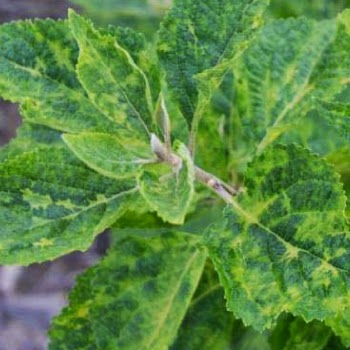
  Leaf mottling, late December Introduction Leaf mottling and wilting, late June. Photo by Tom Becker. Defoliated stem tip with emerging new growth Leaf mottling, Mid July mid July Plant diseases are caused by bacteria, fungi, or viruses. Those caused by viruses are the most difficult to diagnose. Symptoms are often quite subtle, and easily confused with nutrient deficiencies and herbicide injuries. Viral plant diseases are most often transmitted by insect vectors or by infected pruning tools. Once infected, a plant cannot be cured of diseases caused by viruses. Results of Plant Analysis In November 2011, American beautyberries (Callicarpa americana) exhibiting leaf distortion, mottling, and slowed growth were reported to Lee County Extension. Leaf samples were collected from the affected plants and sent to the Plant Disease Clinic at the University of Florida, Gainesville. The sample tested positive for cucumber mosaic virus (CMV) with the Agdia Immunostrip Ki...