Posts

Watersheds, Wetlands, Buffers and the Law
Image
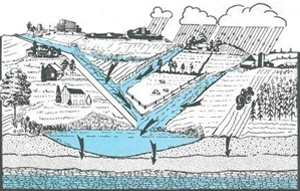
By Peg Lindsay Water flows downhill across parking lots, farms, and yards into reservoirs including ground water aquifers. Image credit: Northwest Florida WMD A watershed (also known as a drainage basin) is a land area that funnels the water that enters it into a common waterbody. Networks of retention/detention ponds, canals and culverts throughout our communities help to facilitate this process. Florida has 29 major watersheds . Most everything you put on your lawn can end up polluting your watershed. That is why a buffering system is so important. Wetland buffers protect the watershed by filtering run-off, protecting water quality, preserving fish and wildlife habitat and also preserving the aesthetic values of the natural watercourse and wetlands areas. Late summer algae blooms can be attributed to excess nutrients (often from fertilizers) in the water. (For more on your local watershed, check out this interactive map .) The littoral zone , the boundary area between the...

Earth Jurisprudence

Image
by Laurie Sheldon Sister Pat Siemen was driving through North Carolina when she popped a Thomas Berry audio book into the cassette deck of her car. The Dominican Sister and attorney was already an advocate of voting rights for the underrepresented and voiceless, so it’s no wonder that a huge lightbulb flashed over her head when the narrator read, "I suspect that if we had an earth governance and every species got to vote, they would vote humans off the planet." Her perception of the rights of nature within the context of the law changed forever on that day - a fact we should all be grateful for. Sister Pat went on to apply her Juris Doctor in the classroom, encouraging Earth literacy as the director of the Earth Ethics Institute at Miami Dade College. She currently heads the Center for Earth Jurisprudence at Barry University's School of Law. Sister Pat Siemen As a speaker at the 2013 F.N.P.S. Conference in May, her presentation began with an introduction to Ea...

Florida's Water and Land Legacy Campaign Goes Digital

Image
Most of you know all about Florida's Water and Land Legacy Campaign. In brief, the goal of the Campaign is to place an amendment to Florida's Constitution on the November 2014 ballot. The amendment, if passed, would provide the Land Acquisition Trust Fund with 33% of the net revenue from the existing document stamp tax, which would be used for the acquisition, restoration, improvement, and management of conservation lands, fish and wildlife habitat, lands critical to our water supply and water bodies, outdoor recreation areas, etc. Why is it necessary? Since 2009, the Florida Legislature has chosen to reduce funding for conservation and restoration programs by almost 100%. This amendment would help to offset the impact of said funding decisions. From the time I was a toddler I was taught to leave any place I visited in the same (or better) condition it was in when I arrived. Shouldn't the same maxim apply with regard to our natural resources? Conservation is a moral imp...

Natives for Landscaping: an FNPS Tool for You

Image
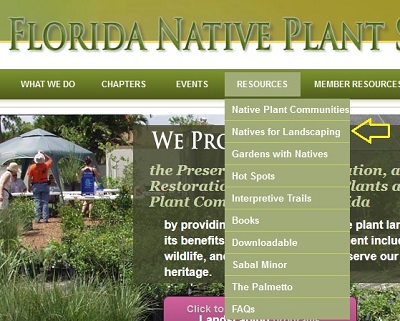
From the homepage of www.fnps.org , use the drop down menu under "Resources" and choose "Natives for Landscaping." The FNPS Website We are fortunate to have a website with so many useful resources, not just FNPS business like finding a chapter, having a calendar of activities, and FNPS news, but also a description of Florida's various plant communities, Florida gardens with natives, and the tool we're covering in this post, Natives for Landscaping .   You can reach this tool by using the drop down menu under "Resources" or you can type its URL: www.fnps.org/plants . You have the option to create a list of natives to fit your requirements or you can find more information about a single plant. Create a List of Natives If you are looking for a range of suggestions to suit your landscaping needs, then place your cursor on your county on the map, then click. You choose your county with your mouse.I choose Clay County After choosing ...

A Bird Garden and a Challenge

Image
By Peg Lindsay My husband and I are birders. People frequently stop us and ecstatically tell us about such-and-such a bird they saw at their feeders, or describe a bird and ask us to help identify it. When my neighbor had Mourning Doves nesting in her trellis, I thrilled at peeking at the baby doves and watching them change and grow. I get excited when I see the first “snowbird” blue-gray gnatcatcher return from its summer home up north. I feel joy when I hear the bugling call of sandhill cranes and proud when I see tiny chicks begin to toddle after their parents. My love affair with birds runs deep, to say the least. That said, it makes sense that I jumped to volunteer at the Palatlakaha Environmental and Agricultural Reserve (P.E.A.R.) Park Bird Garden. I had planned to write this article about all of the plants it contains, some of which are more bird-friendly than others. The species (listed at the bottom of this article) were selected for very particular attributes, includi...

Post Conference Get-Together

Image
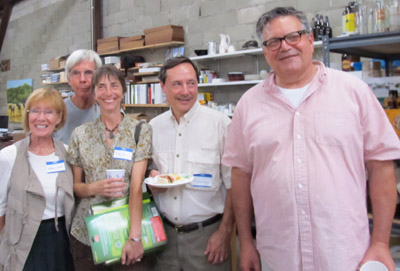
Well, we had a great time at the conference didn't we? Barbara Jackson, the conference chair, did a magnificent job and *things* went off without a single hitch. Yay!  The last conference event was a "Thanks to our volunteers party" at Jim Draper's art studio in Jacksonville. There were great refreshments; we looked at the FNPS Flickr photos of the conference and past conferences (Click the link to see them yourself.); and we enjoyed the ambiance of the art studio. Artist Jim Draper on the right was a keynote speaker at the conference and he offered his art studio for the post-conference party. Barbara Jackson (in the green shirt) was the conference chair. She's way more relaxed now! Laurie Sheldon (in the red dress) is the FNPS social media chair.  Doesn't she do a great job? Art on the wall includes native orchids and sundews as seen on a recent field trip. Drawers full other more art. We've blogged about the 2013 conference s...

Attracting and Creating Habitat for Native Pollinators, Part 3

Image
By Laurie Sheldon For the beginning portions of of this blog, please refer to Native Pollinators, Part 1 and Part 2 Now that we've covered why pollinators are important, what pollination is, who the major players are, and what their lifestyles are like, we can comfortably move on to the last portion of this blog, in which we'll learn how to turn your home landscape (or a portion of it) into a pollinator-friendly habitat. What is a habitat? It is the area in which an organism lives. It consists of both abiotic factors (sunlight, temperature, moisture - physical conditions) and biotic elements (other living organisms - plants, people and predators alike). It follows that, in order for you to create a habitat that can sustain a population of pollinators, you must first take into consideration your site's existing abiotic and biotic attributes. Which spots get the most sun? Are there any damp, shady areas? Is the climate tropical, subtropical or temperate? These i...