Posts

What it's like to adopt a highway by Janina Shoemaker of Sea Rocket Chapter

Image
Sea Rocket Chapter, North Brevard County, held our first Adopt-a-Highway litter pickup with a crew of four, Saturday, October 20, along Columbia Blvd (a major 4-lane to the Space Coast) in 77-80 F weather, (warm but not too humid). We collected a ton (*) of paper, plastic, and some metal trash in under 3 hours, totaling 12 volunteer hours for the society.  Litter Crew: David Humphrey, Janina Shoemaker, and Jim Robey The team considered this a trial learning experience and found that a single sweep of four abreast was more efficient than two pair working both shoulders. We discovered a gopher tortoise meandering along the highway, but also found the remains of a deer and an armadillo, stripped to the bones. Our area of pickup was both sides of the road, in some places about ten feet wide, and in others, a wider expanse past culverts up to fence lines. We noted many native species growing, healthy green-ways, preventing run-off. (The median is NOT included, DOT rules...

Gardening with Natives Open Forum by Carolyn Gregsak

Image
The Mangrove Chapter of the Florida Native Plant Society presented its first meeting of the season on October 9 at Lemon Bay Park in Englewood. More than two-dozen guests were in attendance at the Open Forum, a framework for an interactive, question/discussion session, between the audience and 4-person panel, concerning gardening with native plants in this area of SW Florida. Several first-time attendees were present and we look forward to seeing them throughout the coming season.    The panel consisted of four members of the Mangrove Chapter: Bonnie Moore, Linda Wilson, Al Squires, and Gail Finney. Several questions, submitted prior to the meeting, brought the audience and panel into the full spirit of discussion and debate. Some of the most enthusiastic debate revolved around planting non-native plants with native plants, soil composition, and soil amendments.    Meeting adjournment at eight o’clock seemed to arrive too soon, and many guests lingered to sha...

Bank with Natives in Steinhatchee by Jaya Milam

Image
Big Bend Chapter completed a native plant conversion for our local Citizens State Bank .  We transformed the garden beds from all non-native to all native ! The bank's managers were delighted with the results. They were very pleased to know that there is very low maintenance and the garden beds will shine with natural beauty most of the year! Through this project we were able to share much information regarding the quality and sustainability of going native with many in our community that go past our beautiful Native transformations and get to enjoy the natural beauty.  We were provided the privilege to put our Big Bend Chapter Sign discretely in the corner of each flower bed to encourage folks to consider native when gardening at their home or business facility.  We have received numerous compliments and commendations from many customers and folks just passing by....Go Native, it’s contagious!

Field Trip to Ashton Biodiversity Research and Preservation Institute

Image
On January 20 2018 several members of the Paynes Prairie chapter traveled to Ashton Biodiversity R esearch and Preservation Institute (ABRPI). Chase Pirtle, the animal care specialist and habitat  manager met us at the gate. Chase is an authorized Gopher Tortoise Agent and an instructor and  private land manager for the Eastern Diamondback Conservation Foundation. He also holds a FWC  venomous license. We drove in to the Headquarters and met Maggie Curtis, also a biologist at Ashton who assists Chase in t he management of the facility. The headquarters also serves as an incubator, nursery and cold weather  shelter for the tortoise collection. In large tubs and kiddy pools filled with pine needles and turkey oak  leaves are several Radiated Tortoises (native to Madagascar) and a Yellow Footed Tortoise (native to  South America).  Radiated  Tortoises are critically endangered in Madagascar and these are the  descendants of  ...

Who Doesn't Love a Cocoplum?

Image
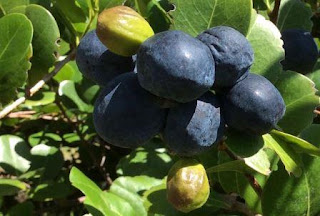
Who Doesn't Love a Cocoplum? By Ellen Broderick Photo by Ellen Broderick Easy to grow here in Martin County with dark purply-blue plums, occasionally white, or unusually pink. Wildlife hide and feast among the offerings of  Chrysobalanus icaco.  In the planned landscape cocoplum's full leafy branches work well as screens, or they can be shaped within garden islands, and even survive buzz-cuts in parking lots. Naturally they grow in South Florida swamps, moist forests, coastal beaches and thickets. Post hurricane their naked branches re-bud and grow new leaves without much fuss.  If you've been around for a while you might know us as the "Cocoplum Chapter." The name was always Martin County but somewhere along the way we picked up the Cocoplum tag. For clarity and with a nod to the Martin County difference we've reclaimed our true name. But it's no big deal if you want to keep calling us cocoplums. They are, after all, very sweet in ...

FNPS Citrus Chapter Member Honored

Image
The Citrus Chapter awarded chapter member, Barbara McCormick the 2018 Green Palmetto Award for Education at our Sept. 4th chapter meeting. The nomination letter was read to the audience. The chapter also gave Barbara a gift card as a thank you for all she does for our chapter along with a bouquet of native bloomers. Barbara's nomination letter is below. March 14, 2018 Citrus County Florida Barbara McCormick, a native Floridian, veteran and former Army officer, joined the Citrus Chapter of the Florida Native Plant Society in 2003. She brought with her many years of experience as a Master Gardener and horticulturalist at Walt Disney World’s University of Disney Garden program while attending Valencia College. In 2002 Barbara started her own nursery named Nature by Design which specialized in native plants as well as Florida friendly plants. Unfortunately the nursery was destroyed by the back to back storms of 2004. Since then, while working as a private co...
Image
Nature in Broward:  The Silent Crisis of Local Rare Species Extinction by Richard Brownscombe A recent review of vegetation maps and firsthand knowledge of Broward natural areas reveals that less than 3.5% of metropolitan land remains for nature. Some ecosystems, such as Scrub, Pine Flatwoods, and Wet Prairie, are now 1% of their size in 1943. Late conservation efforts enabled by Preservation 2000 and Forever Florida gave us a patchwork of small, isolated preserves. Each is important and valuable as a last remnant of a unique subtropical ecosystem. Some have an evolutionary history tens of thousands of years old. Five hundred plant species are living in these metropolitan parks and preserves. By comparison, two hundred plant species live in the large western wetlands, the Everglades Wildlife Management Areas. Therefore, our greatest biodiversity is within metropolitan Broward. Largeflower false-rosemary,  Conradina grandiflora , is endemic to scrub...