Posts

Evil Weeds

Image
By Devon Higginbotham, Suncoast Native Plant Society (originally published in the Plant City Observer ) Spanish Needles is NOT a weed. It is native, a great pollinator plant and edible! “Is that a weed?”  That’s my sister, Candi.  She lives in one of those golf communities where the maintenance crews mow and primp everyone’s yard as well as all the common areas.  I think they allow her a 3 square foot area to “garden”. “No, that’s a Spanish Needle.  It’s a native plant that’s edible and the pollinators adore the flowers”, I replied, sounding a bit defensive.  “Oh” she replied.  She was trying to sound chipper but I knew what she really said was, “I’m not eating any weeds!” She’s my big sister which should explain everything.  Her house and yard are always spotless and manicured, whereas my yard is 15 acres in the middle of nowhere. Anywhere farther than 10 minutes from the nearest grocery store was nowhere to her.  Even her d...

Exciting Things are Happening at FNPS...

Image
In case you missed it, the FNPS Board Meeting and Council of Chapters Meeting was on August 13 at the  FFS Leadership Training Center in Haines City.  If you want to know more about what the Society is doing on the state level to support chapters and further our mission, or if you want to make a meaningful contribution to the society, please consider attending one of the quarterly retreats. Here are some of the  highlights  of what  we discussed and accomplished. To read t he complete summary, along with additional topics, click  here .  Submitted by Donna Bollenbach     FNPS Meets the Wild West…. The venue for the 2017 FNPS conference (May 17-21, 2017) was unveiled and approved by the board, and the winner is  Westgate River Ranch Resort & Rodeo.  In a secluded location just south of US Hwy 60 on the Kissimmee River, Westgate River Ranch is centrally located between the Atlantic and Gulf beaches within Polk C...

Keeping a Nature Journal: Understanding your environment through observation, writing and drawing.

Image
Submitted by Donna Bollenbach. Journal Drawings by Marjorie Shropshire There is no better way to connect with nature than by keeping a nature journal: a collection of observations, interpretations and feelings that describe or illustrate your personal view of the natural world. Nature journals are most commonly in the form of writing, drawing or photographs, or a combination of these.  Nature Journaling is rewarding for both children and adults. It is a great a learning tool, as well as a way to develop a deeper understanding and appreciation of nature by recording and sharing memories. What is a Nature Journal?  Marjorie Shropshire, 2012 A Nature Journal is a personal record, but it is not a diary. A diary is generally about you and your relationships to other people, while a Nature Journal is about your relationship to the natural world-animals, plants, seasons and climates. While you may not want anyone to read your diary, many people enjoy sharing thei...

In Case You Missed It...Noteworthy highlights from the speakers at the FNPS 36th Annual Conference, May 18-22, 2016

Image
Submitted by Sid Taylor The conference was at Dayton Beach Resort right on the Atlantic Ocean.  Surf temp was a warm 78 degrees.  There were Least Terns on the beach. Tom Hoctor. Photo by Vince Lamb Dr. Tom Hoctor, Director of the University of Florida Center for Landscape Conservation Planning , updated us on the status of the Florida Wildlife Corridors and habitat preservation.    With the loss in oversight of growth management at the state level, we need to step in with science to help local governments understand the impact of decisions in new building projects and sprawl.  He quoted Frank Egler:  Ecosystems not only are more complex than we think, but more complex than we can think.  Panthers need a population of 240 individuals to be delisted by the Federal Government as an endangered species.   The Florida Black Bear was delisted four years ago but it still needs corridors for connectivity and exchange of genetic informa...

A Pine can have lightning scars that run down the trunk. Why doesn't an Oak?

Image
  by Cecilia Catron , Tarflower Chapter of the Florida Native Plant Society (reprinted with permission from the August 2016 issue of Tarpaper ) Pine Scar  When days are hot, as they have been for the past month, it seems like a sensible idea to lie in or around the pool all day, like a motionless alligator. Curds of bright, white thunderheads rise higher and higher, expanded by the increasing heat. Gradually air pushed from the east and west coasts meets in the middle of the peninsula. By mid-afternoon it becomes charged by the collision of the fronts and summer lightning is created, with or without a storm. Knotty Oak Have you ever noticed a stripe spiraling down the trunk of a pine tree where lightning has stripped the outer bark off? You may have also noticed there is no such stripe on the trunk of an oak tree. Oaks and Pines, both dominant here in central Florida, have different ligh...

Carol's Corner

Image
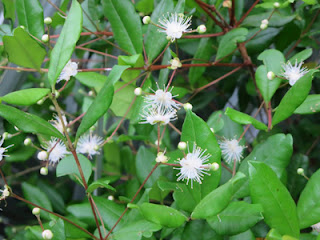
by Carol Hebert, Conradina Chapter of the Florida Native Plant Society The following is a collection of Carol's Corner from the first half of 2016 reprinted in part from the Conradina chapter newsletter. They are the reasons to "Plant Native." Enjoy! May 2016 Simpson Stopper, Photo by Carol Hebert Carol’s Corner: Smells So Good! This wonderful plant is so durable, grows so slowly, and also rewards us with small, beautiful flowers that smell so incredibly wonderful! Simpson Stopper (Myrcianthes fragrans) is categorized as a small tree. I guess you can recognize why the species name is fragrance in Latin. It grows slowly with very little need to prune. I enjoy seeing it used as hedges for commercial businesses. We even have it as a hedge in front of my work place at Dr. Martin Luther King Library on University Boulevard. I loved making my co-workers smell the flowers. It grows on the mainland and beach-side also.   Plant native! C Lupine (Lupinus d...

My Quest for Milkweeds

Image
Story and photos by Janet Bowers, Suncoast Chapter of the Florida Native Plant Society At the beginning of my ‘Natives’ life, I learned a lot from working on the plant sale plant profiles, so I thought the only milkweeds in our area were Asclepias incarnata , A. tuberosa and A. perennis . Apparently those are the ones that nurseries have grown for a while. If I had known better, I might have checked out the USF Plant Atlas where I could have looked up genus Asclepias and would have seen that there are many more species in our area.  Butterflyweed,   Asclepias tuberosa, Lake Blue Scrub I have seen 9 milkweed species so far this year in relative proximity to our area, and I have now done the USF Plant Atlas search so I know there are more out there. An advance search in Hillsborough County lists twelve species.Oddly enough (at least to me), two of the species I have never seen in the wild are the swamp milkweeds that we sell at our plant sale. They are at the top...